“The future belongs to creators who can clearly tell machines what they mean.”
“You don’t need more ideas. You need better translation between your mind and AI.”
In 2026, content creation is no longer limited by creativity — it is limited by clarity of instruction.
Across platforms, studies from major industry reports (including McKinsey’s generative AI insights and Adobe’s creator economy analysis) consistently show that creators who use structured AI prompting workflows produce content up to 3–5x faster and achieve significantly higher content consistency compared to unstructured prompting habits.
But here’s the real shift:
It is no longer about “using AI tools.”
It is about speaking the AI style language — a structured way of describing your idea so AI can accurately reflect your intent.
For many creators, especially those who feel “AI doesn’t get me,” the problem is not the tool.
It is the language mismatch.
The digital century has changed everything about how we create content — and it happened faster than anyone expected. Not long ago, creativity relied mostly on skill, practice, and time. Today, AI can generate visuals, videos, and ideas in seconds. But this new convenience also reveals a painful gap: people who don’t understand AI fall behind, while those who embrace it move forward with incredible speed.
This contrast is becoming clearer every day.
Creators without AI struggle with long editing hours, inconsistent results, and the frustration of not being able to match what they imagine. Meanwhile, creators with AI enjoy faster production, clearer direction, and the ability to generate multiple variations instantly. But even among those using AI, there’s another challenge: AI only works well if you know the right language to speak to it.
And that is the new skill the digital century demands.
The Hidden Pain Point: AI Makes Things Faster, But Also Requires More Knowledge
Yes, AI can do more in minutes than humans once needed hours for — but the catch is this:
To get good results, you must know how to describe what you want.
Creators now need to understand far more than just editing basics. The new digital creative language includes:
- AI style descriptions
- Lighting terms
- Camera angles
- Mood and atmosphere
- Color temperature
- Composition style
- Texture and surface descriptions
- Genre and aesthetic keywords
- Rendering styles (3D, cartoon, cinematic, etc.)
- Subject and environment detailing
This is the “AI vocabulary” every creator must learn.
If you don’t know these words, AI gives you random results. If you do know them, AI becomes your most powerful creative assistant.
Why This Matters More Than Ever
We’re no longer competing with the creators around us — we’re competing with the speed of technology itself. The gap between those who understand AI prompting and those who don’t is widening rapidly.
- Without AI knowledge: results feel “off,” slow, or outdated.
- With AI knowledge: your videos, visuals, and content look polished, modern, and aligned with current trends.
The difference shows immediately.
Brands can see it.
Audiences can see it.
Algorithms can see it.
This is why picking up AI prompting skills is no longer optional — it’s a survival skill in the digital age.
Your Shortcut: A Simple Guide to CapCut AI Style Descriptions
To help creators bridge this gap, here’s a guide to understanding the AI description styles in CapCut — so you can finally get the output you want without guessing.
- Comic Strip / Comic Book
Bold outlines, halftone dots, speech bubbles. - 3D / 3D Cartoon / 3D Render
Pixar-style faces, glossy textures, depth look. - Anime / Manga
Line-art, cel-shading, big eyes, dramatic effects. - Watercolor / Painting / Oil Art
Soft pastel strokes, brush textures. - Sketch / Pencil / Line Drawn
Hand-drawn outline style. - Pixel / Retro / 8-bit
Old-school game style. - Kawaii / Cute Pastel / Soft Girl
Soft colours, sparkles, pastel kawaii stickers. - Neon / Cyberpunk / Futuristic
Glowing lines, neon lights, dark contrast. - Vintage / Film / Grain
Old camera look, warm tones, scratches. - Aesthetic Minimalist
Clean, white space, simple modern layout. - Moody / Dark Cinematic
Deep shadows, dramatic vibes. - Glitch / Distortion
VHS glitch, RGB split. - Portrait Beauty / Makeup Filter
Smooth skin, beauty retouch. - AI Transformation
Turns your photo into:
– Disney style
– Pixar character
– Korean drama look
– Movie poster
– Avatar / Game character
– Realistic painting
Interactive / Movement Styles
- Motion Graphic Text
- Kinetic Typography
- Dynamic Zoom / Parallax
- Velocity Edit Style
- Beat Sync / Auto Beat Sync
By learning the right keywords for style, lighting, mood, and angles, you gain control over your creative direction instead of letting AI decide for you.
What is “AI Style Language” for Creators?
AI Style Language is the structured way of writing prompts that improves AI accuracy, tone matching, and brand consistency.
Instead of:
“Make me a nice Instagram caption”
You say:
“Create a calm, emotionally warm Instagram caption for a wellness brand targeting overwhelmed entrepreneurs. Tone: soft, grounding, slightly poetic. Include one reflective question at the end.”
This shift transforms output quality instantly.
It is the difference between:
- random content
vs - brand-aligned communication systems

Let AI Work For You, Not Against You
You don’t need to become a filmmaker or photographer to thrive in this new digital century — but you do need to understand the language AI listens to. Once you master a few simple style descriptions, everything becomes easier: your workflow speeds up, your visuals improve, and your ideas translate accurately into finished content.
Let this guide be your starting point.
The more you learn how to “speak AI,” the more unstoppable your creativity becomes.
Why This Matters More in 2026 (The Marketer & Creator Reality Shift)
The creator economy is expanding, but attention is shrinking.
Short-form content platforms now reward:
- faster ideation cycles
- consistent visual identity
- algorithm-friendly structure
- repeatable content systems
Reports from creator economy trends suggest:
- Over 70% of creators use AI tools weekly
- But less than 30% feel satisfied with AI output consistency
- And inconsistency is the #1 reason brands lose audience trust
The gap is not AI access.
It is prompt literacy.
CapCut AI Tricks That Amplify AI Style Language
Tools like CapCut are becoming central to modern content workflows.
But most creators underuse it.
Here are practical AI style language + CapCut AI workflows:
1. Script-to-Video Prompting
Instead of uploading raw ideas, structure your script like:
- Hook (emotion trigger)
- Problem statement
- Micro story
- Value point
- CTA
CapCut AI then generates smoother pacing and better scene alignment.
2. Emotional Tone Mapping
Use AI style language tags like:
- “calming / reflective”
- “high-energy motivational”
- “luxury aesthetic storytelling”
- “soft-spoken educational tone”
This dramatically improves auto-captioning + voiceover alignment.
3. Visual Prompt Consistency
Instead of random edits, define:
- color mood
- pacing speed
- transition style
- audience emotion goal
This ensures your videos feel like a brand system, not isolated posts.
The Hidden Skill: Prompt Design = Brand Design
Most creators think branding is:
- logo
- colours
- fonts
But in 2026, branding is increasingly defined by:
“How consistently your content feels across AI-generated outputs.”
AI style language becomes:
- your creative control system
- your consistency engine
- your identity translator
How IreneKreations Helps Creators Build This System
At IreneKreations, we help creators move from scattered ideas to structured AI-powered content systems.
Our focus is especially designed for:
- creators who feel overwhelmed by trends
- business owners struggling with content consistency
- neurodivergent thinkers who need structured creative frameworks
- coaches and freelancers building personal brands
- beginners who “know what they want to say but can’t express it clearly”
What we build with you:
- AI prompt frameworks tailored to your brand voice
- content structure templates (reels, captions, scripts)
- brand consistency systems using AI tools
- simplified workflows for faster creation without burnout
The goal is not to make you “sound like AI.”
The goal is to make AI sound like you, but clearer.
What people are attempting to clarify through search
Q: Can AI images replace stock images completely?
Not fully. AI is great for creative concepts, illustrations, or unique visuals. But stock images still work better when you need credibility, real-life context, or human authenticity.
Q: My videos look great on CapCut but blurry after posting. Why?
This is a platform compression issue, not a design issue.
When you upload, platforms like Instagram and TikTok:
-Re-encode your video
-Reduce bitrate to optimise streaming speed
-Prioritise load performance over original quality
Common causes of blurriness:
-Low export bitrate
-Over-compression before upload (double compression effect)
-Excessively long videos increasing compression pressure
-Uploading over unstable internet, triggering lower-quality processing
Slight improvements:
-Export at higher bitrate (within reasonable file size limits)
-Keep videos concise where possible
-Avoid multiple re-exports before upload
Q: Can I use the same export for Instagram and TikTok?
A: Technically yes, but strategically not ideal.
Both platforms use vertical video, but they differ in how content is processed and surfaced.
TikTok prioritises raw engagement signals and early watch behaviour
Instagram Reels leans more into aesthetic consistency and account history
Using the same export can work, but you risk one platform being slightly under-optimised. Ideally, you adjust minor elements (text placement, safe zones, caption framing) so nothing gets cropped or visually weakened on either platform.
Q: What’s the best file type for all platforms?
A: MP4 (H.264 codec) is the most reliable universal format.
It is widely supported because it balances:
-Good visual quality
-Manageable file size
-Stable compatibility across Instagram, TikTok, Facebook, and most web systems
Other formats may be accepted, but MP4 is the safest standard for consistent delivery.
Q: How can AI be used without losing brand authenticity?
AI should operate as an execution layer, not a decision-maker.
To maintain authenticity:
-Brand direction (tone, values, audience) must be defined first
-AI is used to scale output, not define identity
-Human judgment remains the final filter for tone and relevance
Without this structure, AI tends to produce “statistically correct but emotionally flat” content that lacks identity consistency.
Q: Can AI replace human brand strategy?
A: No. AI can support:
-Idea generation
-Content drafting
-Variations and optimisation
But it cannot replace:
-Brand positioning decisions
-Tone and voice definition
-Audience emotional understanding
-Strategic judgment on what should not be said
AI executes structure. Humans define meaning.

Q: Where can Singapore business owners learn practical AI content skills?
Beyond theory-heavy courses, practical learning comes from applied systems. At IreneKreations, the focus is on helping business owners:
-Build brand-aligned content workflows
-Create usable AI prompts (not just templates) — and build an endless content ecosystem that keeps generating aligned ideas, not random outputs.
-Understand how to structure messaging for real audiences
-Save time by systemising content instead of improvising every time
Q: Can AI images fully replace real photography for businesses?
A: Not entirely. AI-generated images can help with visual creation, but real photography is still essential for accurately representing actual products or people—especially for services that rely on a personal, human touch.
Q: Are AI-generated images good for business use?
Yes, when used intentionally. They are best for conceptual visuals, supplementary content, and creative exploration—not as the sole representation of a brand.
Q: Do customers trust AI images?
Trust really depends on context. In many situations, real images of people, products, or environments tend to build stronger credibility than AI visuals alone.
That said, I do also see AI-generated visuals that are real scroll-stoppers—highly creative, visually striking, and conceptually unique. The impact really comes down to having strong ideas and the ability to prompt clearly and precisely to get the intended result.
Q: What is the risk of relying too much on AI visuals?
If you rely on generic prompts or a simple question-and-answer approach, you’ll likely end up with generic results that aren’t very useful or usable.
Over-reliance can also lead to bland or dilute branding, reduced trust, and inconsistency—especially when the visuals don’t align with your brand’s voice, positioning, and overall identity.
Q: How does AI affect content creation for businesses?
A: AI can significantly accelerate content and production workflows, enabling businesses to create faster than ever before. However, speed without clarity often leads to amplified confusion rather than better outcomes. If your messaging, brand identity, or strategic direction is unclear, AI will simply replicate and scale that inconsistency across multiple outputs. This results in content that feels misaligned, inconsistent, or ineffective. Instead of solving underlying issues, it magnifies them. To fully benefit from AI, businesses must first establish clear positioning, messaging, and intent—so the technology enhances precision and impact, rather than spreading confusion at scale.
Q: Why does some AI-generated content feel “off” even if it looks correct?
A: Because correctness is structural, not emotional.
“Off” content usually lacks:
Emotional tone alignment
Audience-specific nuance
Brand voice consistency
Intent clarity (what the content is trying to achieve)
AI can replicate form, but it cannot infer brand sensitivity unless that framework is explicitly defined.
Conclusion: The Future Belongs to Structured Marketers & Creators
In 2026, creativity is no longer the problem — clarity is.
Those who learn AI style language will:
- create faster
- build stronger brands
- reduce creative burnout
- scale content without losing identity
And those who don’t will continue feeling like AI is “almost right, but not quite.”
The truth is simple:
AI does not need you to be more creative — it needs you to be more precise.
So the real question becomes:
Are you ready to learn how to speak in a way that AI finally understands you?
✧⭒✦✧⭒✦◇ Get Social Media | Branding | Marketing | Content Strategy Support in Singapore ✦⭒✧✦⭒✧
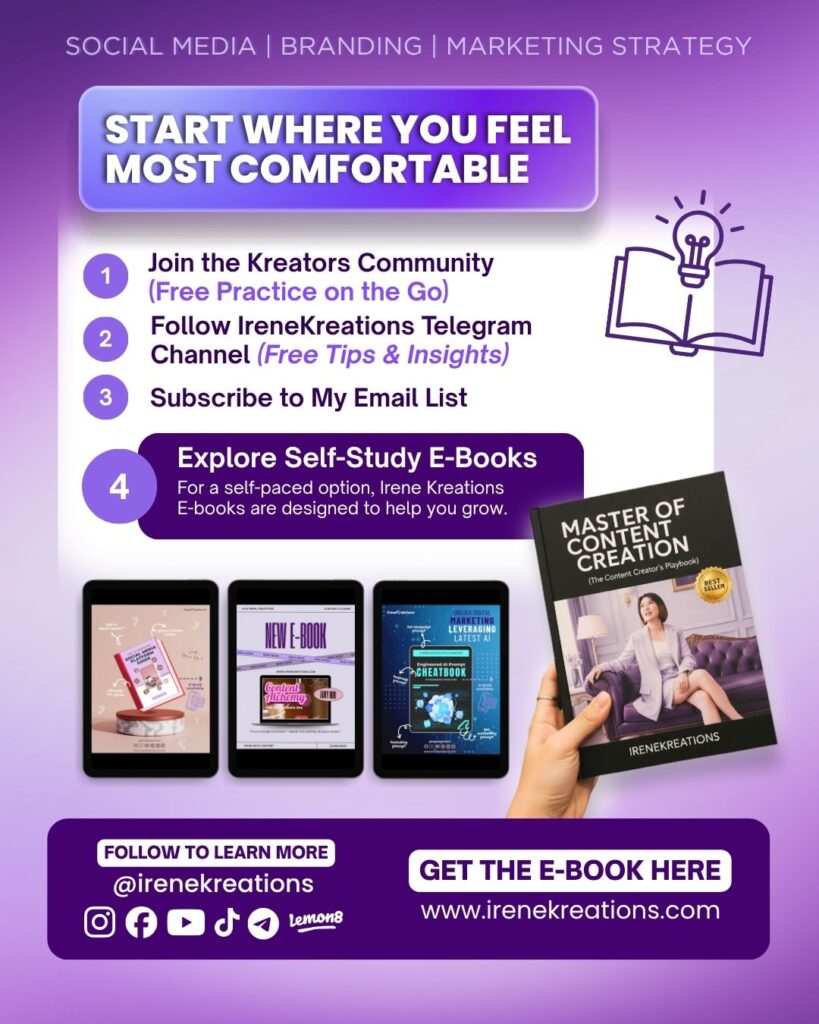
You can start in a way that feels more comfortable:
1. Join the Kreators Community (Free)
A supportive, non-transactional space where creators and business owners come together to learn, share, and grow.
It’s not about hard selling or competition — it’s more like a kampung-style environment where people:
-Exchange ideas and experiences
-Learn from Irene on the ground in a practical content creation session
-Build genuine connections with other creators & business owners
The focus is on growing together, not performing alone.
👉 [Join Kreators Community]
2. Explore Self-Study E-Books
If you prefer to process things at your own pace, IreneKreations E-books are designed to help you:
-Think clearer about your content and positioning (for a specific niche)
-Understand why you’re stuck (not just what to do)
-Build your own structure without overwhelm
👉 [Browse Growth Hacks E-Books Library]
3. Follow My Telegram Channel (Free Tips & Insights)
If you’re still observing and learning, this is a good place to start.
I regularly share:
-Practical content and branding insights
-Realtime Tips or Customer’s Proven Case Study
-Real thoughts behind strategy (not just surface tips)
-Observations from real business and creator experiences
-At times, leveraging AI for content marketing tips
👉 [Join IreneKreations Telegram Channel]
4. Subscribe to My Email List (Free Insights)
If you prefer something simple, you can join my mailing list.
This is where I share:
-Deeper breakdowns of Marketing knowledge and experience sharing
-Insights I don’t always post on social media
-Practical reflections to help you think more clearly about your direction
It’s designed for people who want steady clarity over time, not just quick tips.
👉 [Subscribe to Email List]
You don’t have to figure everything out alone.
But you also don’t have to rush your process.
Whether you prefer:
-Talking things through
-Learning at your own pace
-Getting small consistent insights
-Or simply observing for now
There’s a space for you here, built and supported by IreneKreations.