A reflection for business owners who want to do their own marketing—but feel something isn’t clicking.
Marketing today is louder than ever.
Advice is everywhere. Courses promise fast results. Algorithms change weekly.
Yet many beginners and students who try to learn marketing end up feeling more confused than when they started.
This isn’t because they are not capable.
Often, it’s because they started learning from the wrong inspiration.
At IreneKreations, we often meet business owners who say:
“I’ve taken courses, watched tutorials, followed strategies… but my marketing still doesn’t feel like me.”
That experience is more common than people think.
Because marketing mistakes are rarely technical mistakes.
Most of the time, they are thinking mistakes.
Here are three common mistakes beginners and students often make when learning marketing—and how to avoid them.
1. Starting With Tactics Instead of Identity
“Having values doesn’t automatically make a brand.”
Many beginners learn marketing through tools and tactics first:
- Instagram growth hacks
- TikTok posting formulas
- AI content generators
- SEO templates
- Reels strategies
But very few courses start with the most important question:
Who are you as a brand?
Without that clarity, every tactic becomes random.
You might be posting consistently, but something still feels off.
Why this happens
Beginners assume marketing is about activity:
- Post more
- Comment more
- Follow trends
But real marketing starts with identity:
- What does your brand stand for?
- How should people feel when they encounter you?
- What kind of voice reflects your business?
Without those answers, consistency becomes difficult.
“Inconsistency is often an identity problem, not a skill problem.”
What experienced marketers do differently
Professionals usually start with:
- Brand positioning
- Brand tone
- Audience psychology
- Message clarity
Because once those are clear, content becomes easier.

2. Learning From Too Many Voices at Once
“Slow growth feels wrong in a world obsessed with speed.”
Another common mistake beginners make is consuming too much marketing advice at the same time.
One expert says:
- Post 3 times a day.
Another says:
- Post once a week.
Another says:
- Only make video content.
Another says:
- Focus on long-form articles.
Eventually the learner feels stuck.
Not because they lack information.
But because they have too much conflicting information.
The real issue
Marketing advice online often comes from different contexts:
- Influencers
- Personal brands
- E-commerce sellers
- Agencies
- Corporate marketers
What works for one context may not work for another.
A local business owner in Singapore has a very different marketing reality compared to a global influencer.
What beginners should remember
Marketing is not only about what works.
It’s about what works for your brand and situation.
“If marketing feels fake, you’re using someone else’s voice.”
When beginners copy strategies blindly, their marketing often feels forced or unnatural.
And audiences can sense that.
3. Trying to Outsource Thinking Too Early
Many small business owners eventually feel overwhelmed and decide to:
- hire an agency
- hire freelancers
- outsource social media
Outsourcing can be helpful.
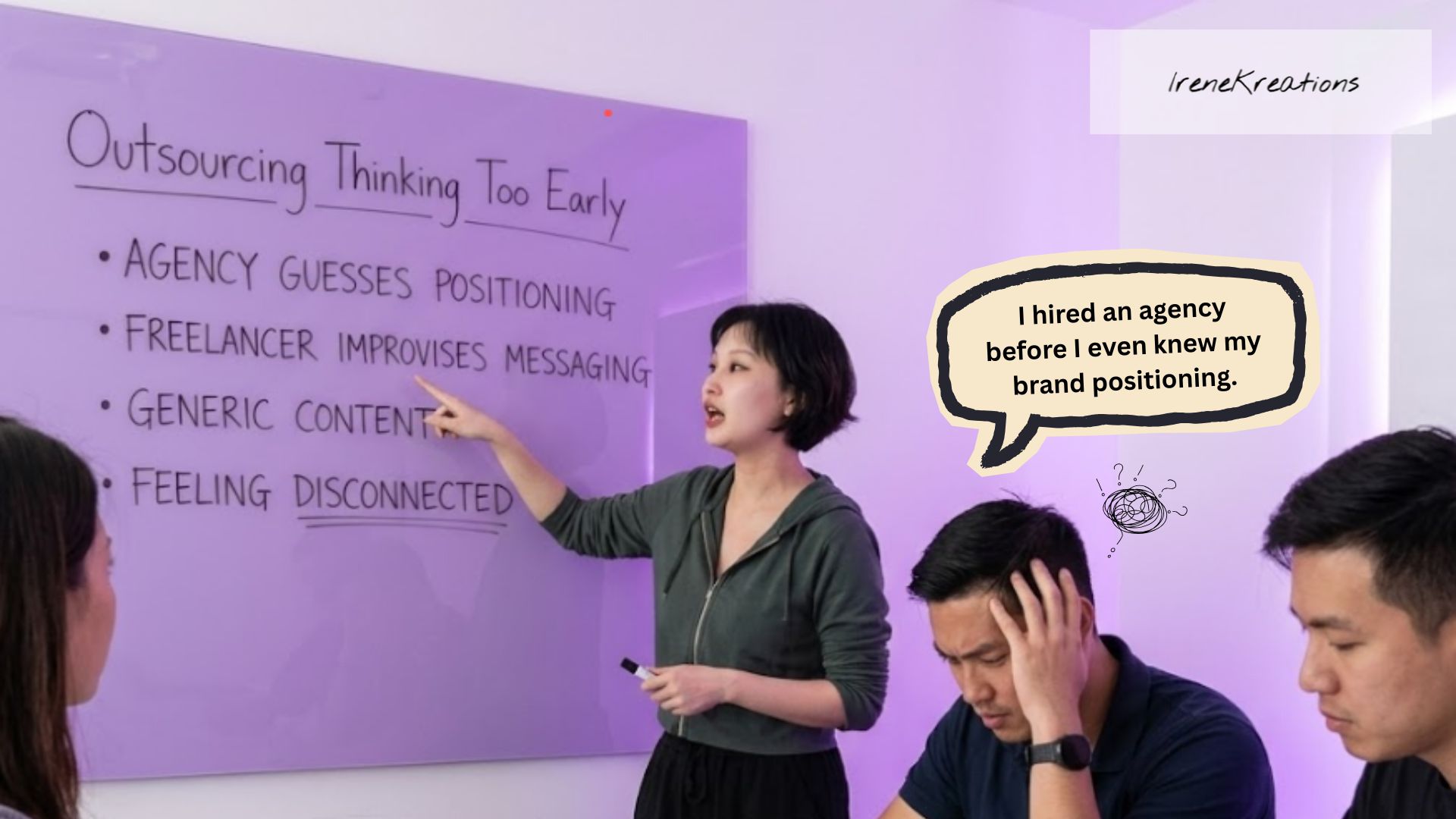
But a common mistake is outsourcing before understanding your own brand.
When that happens:
- agencies guess your positioning
- freelancers improvise messaging
- content becomes generic
And the business owner still feels disconnected from the brand.
“Handing over your brand shouldn’t feel like giving up your voice.”
The goal of marketing support should not be replacing your voice.
It should be helping you understand it better.
Why Many Small Business Owners Struggle With Marketing
The problem is rarely effort.
Most business owners are already working extremely hard.
The real difficulty is reflection.
Running a business makes it hard to step outside your own brand.
That’s why this idea resonates with many founders:
“You can’t read the label when you’re inside the bottle.”

Why Learning With an Expert Often Works Better
Courses, bootcamps, and templates can be useful.
But many business owners eventually realise something important:
Marketing knowledge is not the same as marketing clarity.
Here is where 1-on-1 coaching or consultation can make a difference.
Courses
✔ Structured learning
✔ Affordable
But often:
- generic examples
- limited personal feedback
Bootcamps
✔ Intensive learning
✔ community support
But often:
- fast paced
- limited time to reflect on your own brand
1-on-1 Coaching
✔ Personalised guidance
✔ brand-specific insights
✔ real-time feedback
Most importantly, coaching helps answer the questions many courses cannot:
- Why doesn’t my content feel aligned?
- Why is my messaging inconsistent?
- Why does marketing feel uncomfortable?
How IreneKreations Approaches Marketing Differently
At IreneKreations, the focus is not just on what to post.
The focus is on how to think about branding and content.
Because when thinking becomes clearer, decisions become easier.
What makes the approach different
🌱 Brand essence before trends
Before discussing content strategy, we clarify what your brand represents.
🌱 Credibility over quick visibility
Strategies focus on building trust, authority, and long-term brand value.
🌱 Emotional alignment in messaging
Content should not only look consistent—it should feel right for the brand.
🌱 Sustainable systems
Marketing systems must match real time, energy, and capacity.
🌱 Pre-trend insight
As an active social media agency, shifts in platforms are often spotted earlier through testing.
This is why IreneKreations often says:
“We don’t just teach what tool to use.
We teach how to think, see, and decide.”
A Different Kind of Marketing Education
The goal at IreneKreations isn’t to create trend-chasing marketers.
The goal is to help business owners communicate with:
- clarity
- calm confidence
- integrity
Even in a fast, AI-driven world.
Because the future of branding will not belong to the loudest voices.
It will belong to businesses that are:
- trusted
- remembered
- aligned with who they truly are.
Many Beginners Asked:
Q: How do I know if I need marketing coaching?
A: You likely need structured guidance if you experience:
-High knowledge but low execution consistency
-Frequent overthinking about what to post or how to position
-Content that feels inconsistent or not aligned
-Difficulty translating ideas into actual content systems
-Repeated cycles of starting and stopping strategies
These are usually not knowledge gaps—they are structural clarity gaps.
Q: Is there a way to learn marketing without burnout?
A: Yes—by reversing the learning sequence and building from clarity first.
A sustainable approach looks like this:
-Start with brand clarity (who you are, who it’s for, how you sound)
-Define audience needs (what they actually struggle with daily)
-Build simple systems (repeatable content frameworks, not constant reinvention)
-Set capacity limits (what you can realistically maintain without exhaustion)
To support different learning styles and energy levels, IreneKreations also offers different support options:
🎥 Kreators Community Event (Practical Sessions)
Join hands-on sessions where you can learn, test ideas, and apply concepts in real time with guidance—ideal if you prefer interactive learning and immediate feedback.
📖 E-book (Self-paced Learning)
Learn at your own time, at your own pace, with no pressure to keep up. You can revisit concepts whenever you’re ready and apply them gradually based on your own target and schedule.
Both paths are designed with one intention:
to help you grow your marketing clarity without stress, pressure, or burnout.
Q: Why do most people fail at self-learning marketing?
A: Failure usually happens not from lack of learning, but from lack of systemisation.
Common pattern:
-Consuming many frameworks, tips, and trends
-Trying different methods inconsistently
-Switching strategies before results compound
-Never building a repeatable execution system
So knowledge increases, but output remains unstable.
Q: Why does some AI-generated content feel “off” even if it looks correct?
A: Because correctness is structural, not emotional.
“Off” content usually lacks:
Emotional tone alignment
Audience-specific nuance
Brand voice consistency
Intent clarity (what the content is trying to achieve)
AI can replicate form, but it cannot infer brand sensitivity unless that framework is explicitly defined.
Q: What’s the difference between posting strategy and brand strategy?
A: They operate on completely different levels.
Posting strategy = execution layer
It tells you what to post, when to post, and how often
It is schedule-based and operational
Brand strategy = meaning layer
It defines why the content exists, who it’s for, and what perception it builds over time
Without brand strategy, posting becomes random activity.
With brand strategy, every post becomes part of a consistent narrative that builds recognition, trust, and positioning.
A Final Reflection
Marketing doesn’t have to feel overwhelming.
But clarity usually comes from stepping back before pushing forward.
Because sometimes the real issue is not effort.
It’s perspective.
“You can’t read the label when you’re inside the bottle.”
And sometimes, having someone outside the bottle helps you finally see it clearly.