Most business owner interviews die in the scroll within three seconds — not because the business is boring, but because the questions are.
If you’re a business owner trying to “share your story” but struggling to make it resonate, rank, or convert — this is where the gap lies.
In a sea of repetitive content, interviews often become “just another post”… unless you know how to turn them into magnetic storytelling assets, SEO powerhouses, and short-form content goldmines that make your brand impossible to ignore.
So what exactly do readers crave in an interview?
And how do you craft content that’s not only interesting, but also highly searchable, strategically local, and capable of earning its way into Google’s “People Also Ask” section?
Let’s break it down.
Why Most Business Interviews Don’t Work
Let’s be direct.
Most interviews sound like:
- “I started my business because…”
- “My passion is…”
- “We provide high-quality services…”
❌ Generic
❌ Forgettable
❌ Not searchable
❌ No emotional hook
The deeper issue 👇
Business owners often:
- Can’t step outside their own perspective
- Don’t know what their audience actually cares about
- Mistake storytelling for clarity
And yet — they still want to do it themselves.
That’s exactly the gap IreneKreations is built to solve.
What Readers Actually Want (But Won’t Tell You)
When someone clicks on a business owner interview, they are subconsciously asking:
1. “Is this person credible?”
They want proof, not passion.
👉 Show:
- Real decisions you made
- Trade-offs
- Failures and adjustments
2. “Can I see myself in this story?”
People don’t read to admire you.
They read to relate to themselves.
👉 Include:
- Specific struggles (cashflow, inconsistency, self-doubt)
- Turning points
3. “What can I learn from this quickly?”
Attention span is short. Clarity wins.
👉 Deliver:
- Lessons
- Frameworks
- Decision-making logic
4. “Why should I trust this brand?”
Trust is built through alignment, not hype.
👉 Show:
- Consistency in thinking
- Clear brand values
- Calm confidence (not loud marketing)

Questions Interviews Website Owners asked online:
Q: Does sharing my content to Social media groups really help?
A: Yes—but only when used strategically.
Group sharing helps by:
-accelerating initial visibility
-generating early engagement signals (likes, saves, comments)
-helping the platform “test” your content faster
However, it only works if:
-the group is relevant to your content topic
-your post already has a clear hook and value
If the content is weak or misaligned, sharing more won’t fix performance—it just amplifies the same issue.
Q: How do I know if my content is aligned with my brand?
A: Check for repeatability and recognition.
Ask:
-Does it sound like me without forcing it?
-Would the same audience consistently recognise this style?
-Does it feel natural to repeat weekly without exhaustion?
-Does it attract the right people, not just more people?
If your content only works when you “try hard,” it’s not aligned yet. If it feels natural but still intentional, you’re close to alignment.
Q: What branding mistakes do Singapore SMEs often make?
A: Common issues are usually not about effort—but about direction.
Frequent mistakes include:
-Inconsistent tone across platforms (confuses trust signals)
-Focusing only on promotion instead of meaning
-Ignoring deeper emotional motivations behind purchases
-Copying trends without brand alignment
-Changing messaging too frequently based on short-term results
These issues slowly weaken perception even if content output is high.
Q: How do I understand my audience on a psychological level?
A: Understanding your audience goes beyond demographics—it is about decision psychology.
Focus on:
-Needs: What they are actively trying to solve or improve
-Fears: What they want to avoid (loss, regret, waste, embarrassment, etc.)
-Motivations: What outcome they are really chasing emotionally
-Decision patterns: How they evaluate trust before buying
Most buying decisions are not logical first—they are emotional first, then justified logically after.
Q: What is an entry point in marketing?
A: An entry point is the first moment of relevance—the hook that makes someone stop, pay attention, and mentally connect to your message before they even know your offer exists.
It is not the product. It is not the promotion.
It is the attention gateway that frames why the rest of your content matters.
A strong entry point does three things:
Signals “this is for me” within seconds
Connects to a real situation, feeling, or frustration
Opens curiosity before any selling begins
Without a clear entry point, even good offers feel invisible because there is no “reason to care yet.”
More Insights:
1. People Want Real Insights, Not Perfect Stories
Most business interviews sound like this:
- “Tell us about your business.”
- “What inspired you?”
- “What challenges did you face?”
These are overused. They create dull, predictable content that readers scroll past.
What people actually want are:
- Behind-the-scenes truths
- Mistakes and lessons
- Personal turning points
- Specific tactics that worked
- Human moments they can relate to
- Emotions, struggles, and growth
When you include these elements, readers stay longer, connect deeper, and share more.
Example of interesting angles:
- “The biggest mistake I made in my first year of business.”
- “One thing I thought would work, but completely failed.”
- “The turning point that saved the business from collapsing.”
- “A habit that doubled my revenue unexpectedly.”
This creates meaningful content instead of shallow “template interviews.”
2. People Want Short, Snackable Answers (for Social Media)
For reels, TikToks, and short clips, script your interview with clippable questions:
- “What’s a belief you strongly disagree with in your industry?”
- “What’s a small mindset shift that changed your business?”
- “What’s a mistake most new business owners make?”
- “What’s one decision that changed everything?”
These create strong, high-retention short-form content because:
- They spark curiosity
- They invite emotionally charged answers
- They make people comment with their own beliefs
Use this rule for short-form content:
Ask questions that trigger opinions, emotions, or curiosity.
3. People Want Searchable Content (SEO + Local SEO)
When creating interview content, you’re not just telling a story—
you’re building SEO assets that can rank for months or years.
(A) Local SEO — Geo-Targeted FAQs
Add questions that local audiences search for:
- “Why did you choose to build your business in Singapore?”
- “What makes your service unique for people living in Singapore?”
- “How do you serve the needs of customers in (specific neighbourhood)?”
- “What do most customers from (area) struggle with before coming to you?”
This helps Google understand:
- your business category
- your local relevance
- your neighbourhood authority

(B) Long-Tail Question SEO
The future of SEO = long questions people type or speak into Google and AI.
Examples:
- “What’s the biggest challenge small business owners face in Singapore 2025?”
- “How does a first-time entrepreneur get customers without advertising?”
- “What should I know before engaging a printing business for packaging?”
These wordy questions help you rank faster because they have lower competition.
(C) Blue Ocean Questions (Uncommon but attention-grabbing)
These questions help you stand out from all the generic interview content.
Examples:
- “What is a customer behaviour you didn’t expect when you first started?”
- “What is something about your industry nobody talks about, but more people should know?”
- “What is the weirdest request a customer has ever made?”
- “What did you stop doing that dramatically improved your results?”
These questions give your content a “fresh angle,” leading to:
- Higher watch time
- More shares
- Greater likelihood to appear in Google’s People Also Ask
4. Craft “Future-Proof Questions” That Can Rank in Google’s ‘People Also Ask’
If you want your interview article to appear under PAA, ask questions that begin with:
- How do I…
- Why does…
- What is the difference between…
- When should I…
- Is it necessary to…
Combine them with long-tail phrases + locality.
Examples:
- “Why do business owners in Singapore struggle with building online visibility?”
- “How do small restaurants in Singapore attract new customers without ads?”
- “Is it necessary for new business owners to invest in personal branding early?”
- “What is the difference between hiring a freelancer, agency, or employee for content creation?”
These questions have future ranking potential because they match real search behaviour.
5. Add New, Unanswered Questions to Create Blue Ocean SEO Gaps
Google rewards original questions that few people have asked or answered.
Try adding questions like:
- “What is a business lesson you learned from your first negative customer?”
- “How do you balance quality and cost when running a local service business?”
- “What part of running a business is emotionally hardest for you, and why?”
- “What’s one thing the public misunderstands about your industry?”
- “What trend do you see in the next 3 years that people still don’t notice?”
These help Google see your article as fresh, unique, and answer-rich, making it more likely to be surfaced in “People Also Ask.”
6. How to Make the Entire Interview Interesting
Here’s your content formula:
✓ Mix human stories + useful tips
People want emotions + practical insights.
✓ Use contrast
Ask questions like:
- “Before vs Now”
- “Biggest challenge vs biggest win”
- “What you believed then vs what you know now”
✓ Add conflict and turning points
Every great interview includes a moment of:
- tension
- surprise
- a painful lesson
- a comeback story
✓ Include “first-person emotional lines”
Examples:
- “I still remember the day…”
- “I almost gave up when…”
- “Nobody told me that…”
These lines hook readers immediately.
✓ Repurpose into short-form content
Each question becomes:
- 1 article section
- 1 reel
- 1 carousel slide
- 1 quote graphic
- 1 LinkedIn post
One interview = 5 to 10 pieces of content.
7. Sample Question Bank for High-Impact Interview Content
You can use this directly:
SEO + Local SEO
- What do customers in Singapore commonly misunderstand about your service?
- Why did you choose to locate your business in (neighbourhood)?
- How do you solve problems specifically faced by customers in (district)?
- What do local customers value most in your business?
Long-Tail Questions
- What was the biggest turning point that helped your business grow?
- What is the most unexpected challenge you faced and how did you solve it?
- How do you maintain work-life balance as a business owner?
- What advice do you wish someone gave you before you started?
Blue Ocean Questions
- What is something you stopped doing that made your business better?
- What’s a myth about your industry that needs to change?
- What is an unpopular opinion you have about your own industry?
- What’s a habit you developed that gave you strong results?
PAA-Optimized Questions
- Why do small businesses fail in their first 2 years?
- How should a business owner choose between paid ads vs organic content?
- What is the difference between brand marketing vs sales marketing?
- When should a business start investing in SEO and content?

8. Final Thoughts — Why Interviews Are a Powerful Long-Term Strategy
A well-crafted business owner interview can become your:
- Evergreen SEO article
- Local authority builder
- “People Also Ask” magnet
- Lead-generation content
- Short-form video script
- Personal branding asset
- Partnership pitch material
- Trust-building storytelling tool
The goal is simple:
–Ask deeper, more human, more specific, more surprising questions.
–Turn the business owner’s story into educational, searchable, emotional content.
–Make readers feel inspired, understood, or enlightened.
When you do this consistently, your interview content won’t just be read—
it will be remembered, shared, ranked, and recommended.
The information people are actively seeking clarity on
Q: Why is branding important for small business in Singapore?
Branding is important because it reduces uncertainty in a highly competitive, comparison-driven market.
In Singapore, consumers are exposed to many similar options. A strong brand creates:
-Emotional clarity (why this business feels right)
-Trust signals (why it feels safe to engage)
-Recognition (why it feels familiar even before experience)
Without branding, businesses compete on price or visibility. With branding, they compete on perception and trust.
Q: What makes marketing feel overwhelming for small business owners?
Marketing becomes overwhelming when the learning path is backwards.
A: Most education starts with:
-Tools (AI, ads, platforms)
-Tactics (hooks, trends, formats)
But it skips the foundation: brand identity and message clarity.
So business owners end up doing a lot of activity without direction. The result is:
-Too many platforms, not enough focus
-Constant content pressure
-Conflicting advice from different “gurus”
-Confusion about what actually matters
Overwhelm is not from lack of effort—it’s from lack of structure.
Q: Can small businesses in Singapore do influencer marketing without agencies?
A: Yes, you can absolutely manage it on your own—if you have the time, communicate clearly online, stay consistent with follow-ups, and are committed to checking in with influencers and creators all the way through to completion.
Q: What branding mistakes do Singapore SMEs often make?
A: Common issues are usually not about effort—but about direction.
Frequent mistakes include:
-Inconsistent tone across platforms (confuses trust signals)
-Focusing only on promotion instead of meaning
-Ignoring deeper emotional motivations behind purchases
-Copying trends without brand alignment
-Changing messaging too frequently based on short-term results
These issues slowly weaken perception even if content output is high.
Q: How do I understand my audience on a psychological level?
A: Understanding your audience goes beyond demographics—it is about decision psychology.
Focus on:
-Needs: What they are actively trying to solve or improve
-Fears: What they want to avoid (loss, regret, waste, embarrassment, etc.)
-Motivations: What outcome they are really chasing emotionally
-Decision patterns: How they evaluate trust before buying
Most buying decisions are not logical first—they are emotional first, then justified logically after.
The Real Shift: From “Creating Content” to “Communicating Context Clearly”
This is where most people miss the point.
It’s not about:
- Tools
- Templates
- Trends
It’s about:
👉 How you think
👉 How you see
👉 How you decide
And that’s exactly what IreneKreations teaches.
✧⭒✦✧⭒✦◇ Get Social Media | Branding | Marketing | Content Strategy Support in Singapore ✦⭒✧✦⭒✧
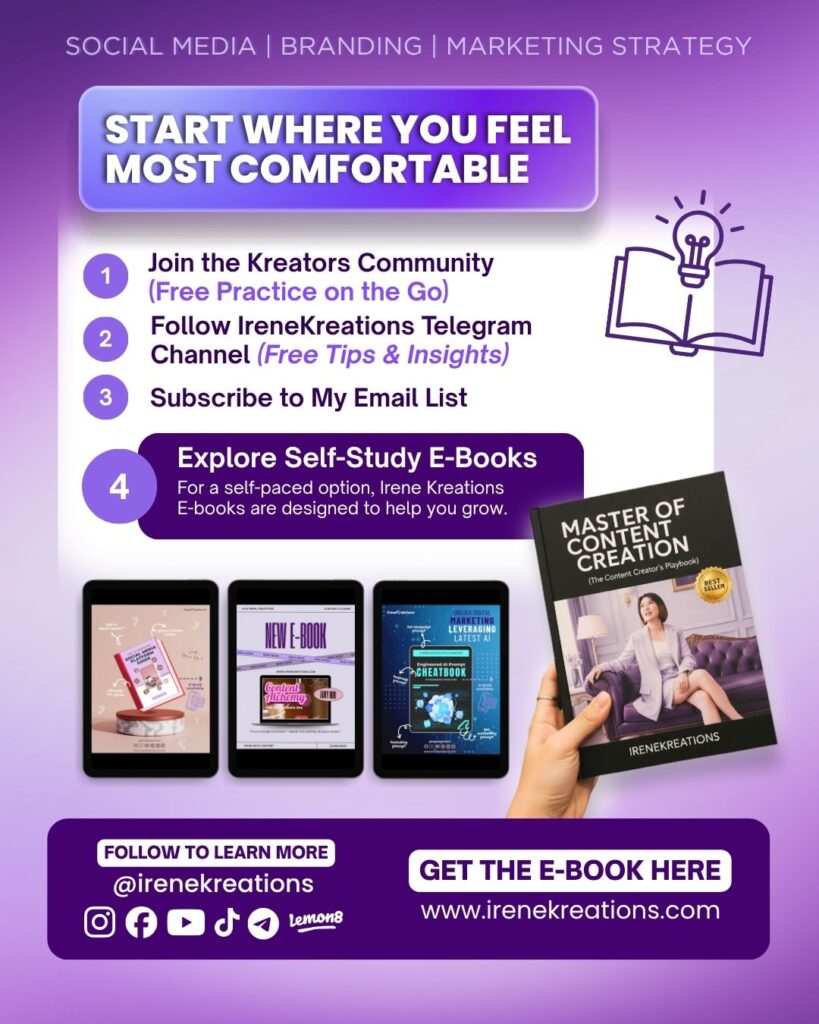
You can start in a way that feels more comfortable:
1. Join the Kreators Community (Free)
A supportive, non-transactional space where creators and business owners come together to learn, share, and grow.
It’s not about hard selling or competition — it’s more like a kampung-style environment where people:
-Exchange ideas and experiences
-Learn from Irene on the ground in a practical content creation session
-Build genuine connections with other creators & business owners
The focus is on growing together, not performing alone.
👉 [Join Kreators Community]
2. Explore Self-Study E-Books
If you prefer to process things at your own pace, IreneKreations E-books are designed to help you:
-Think clearer about your content and positioning (for a specific niche)
-Understand why you’re stuck (not just what to do)
-Build your own structure without overwhelm
👉 [Browse Growth Hacks E-Books Library]
3. Follow My Telegram Channel (Free Tips & Insights)
If you’re still observing and learning, this is a good place to start.
I regularly share:
-Practical content and branding insights
-Realtime Tips or Customer’s Proven Case Study
-Real thoughts behind strategy (not just surface tips)
-Observations from real business and creator experiences
-At times, leveraging AI for content marketing tips
👉 [Join IreneKreations Telegram Channel]
4. Subscribe to My Email List (Free Insights)
If you prefer something simple, you can join my mailing list.
This is where I share:
-Deeper breakdowns of Marketing knowledge and experience sharing
-Insights I don’t always post on social media
-Practical reflections to help you think more clearly about your direction
It’s designed for people who want steady clarity over time, not just quick tips.
👉 [Subscribe to Email List]
You don’t have to figure everything out alone.
But you also don’t have to rush your process.
Whether you prefer:
-Talking things through
-Learning at your own pace
-Getting small consistent insights
-Or simply observing for now
There’s a space for you here, built and supported by IreneKreations.