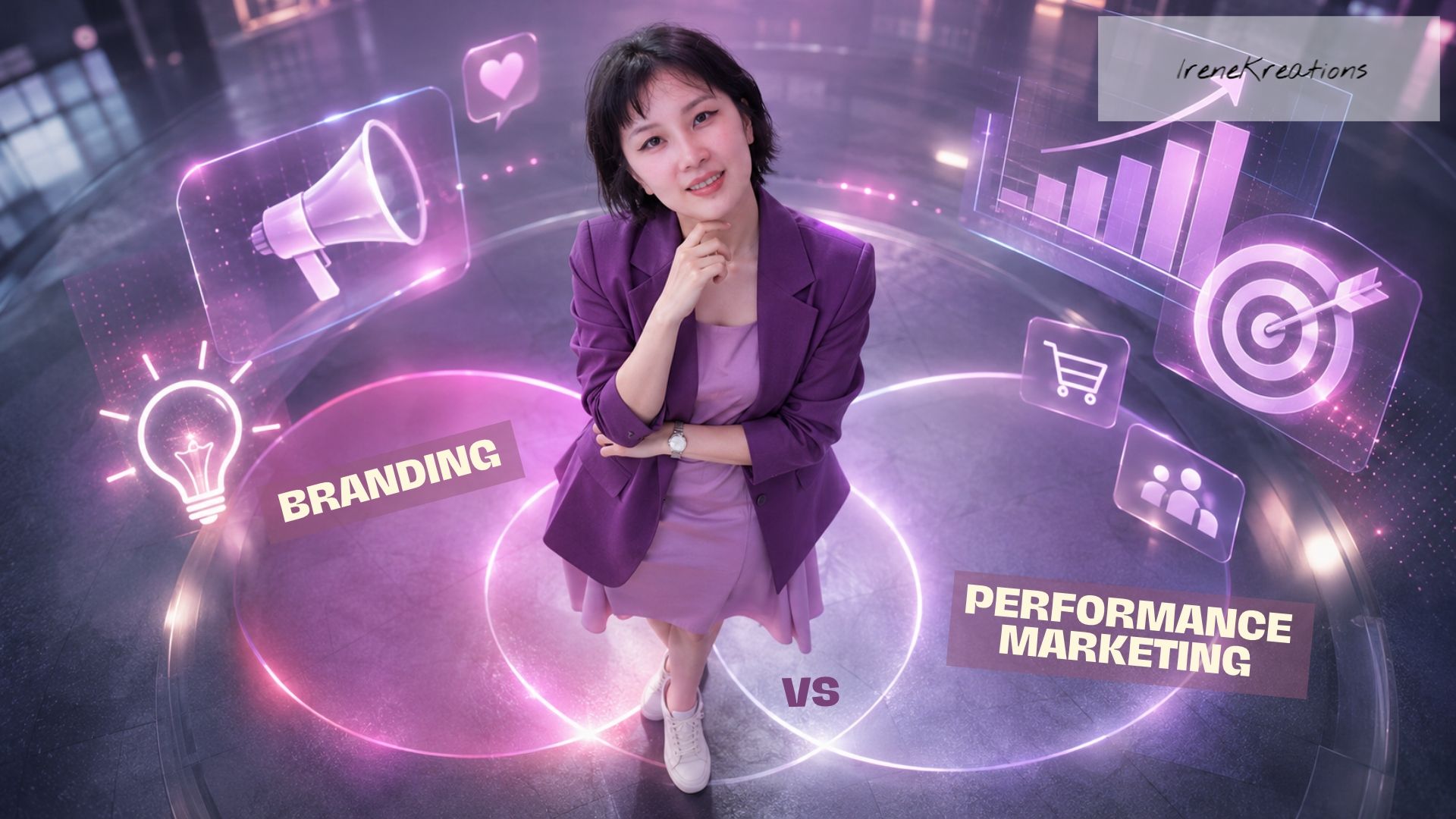
Additionally, a used-to-be branding specialist once told me something that caught my attention about Branding vs Performance Marketing.
“I switched to performance marketing.”
Not because he suddenly stopped believing in branding.
But because more business owners today only care about one thing.
Sales.
If Branding vs Performance Marketing doesn’t generate leads this month, many businesses immediately assume it isn’t working.
Meanwhile, performance marketing can produce enquiries within days through Meta Ads, Google Ads or TikTok Ads.
From a business owner’s perspective, that’s understandable.
If your business needs cash flow, you’ll naturally choose the method that gives immediate results.
To a certain extent, I agree.
As someone who provides branding services, I won’t tell you branding alone will magically generate customers.
It won’t.
But after working with brands across different industries, I’ve also noticed something else.
Businesses that rely purely on paid advertising eventually become dependent on paid advertising.
Every month becomes another advertising bill.
Every campaign starts from zero.
Every algorithm update becomes a business risk.
That’s where branding quietly becomes one of the most valuable long-term business assets.
In Short:
-Performance marketing creates immediate opportunities.
-Branding creates lasting demand.
-The most successful businesses don’t choose one over the other—they make both work together.
-Performance marketing gets people to discover you.
-Branding gives them a reason to trust you, remember you and eventually choose you.
-When these two strategies are aligned, every marketing dollar works harder because your advertising is also building future brand equity.

What Is Branding?
-Branding is much more than a logo or attractive colours.
-Branding is the memory people have about your business.
-It’s what comes into someone’s mind when they hear your company name.
-It’s the feeling they associate with your products.
-It’s the expectations people develop before they even contact you.
Branding answers questions like:
- Why should I trust you?
- What do you stand for?
- Who are you built for?
- Why should I choose you over someone cheaper?
Good branding creates familiarity.
Familiarity creates trust.
Trust reduces buying hesitation.
What Is Performance Marketing?
Performance marketing focuses on measurable business outcomes.
Examples include:
- Facebook Ads
- Instagram Ads
- Google Search Ads
- TikTok Ads
- LinkedIn Ads
- Lead Generation Campaigns
- Conversion Campaigns
Every dollar spent aims to generate:
- Leads
- Sales
- Website traffic
- App downloads
- Phone enquiries
Performance marketing is excellent because results are measurable.
However, many businesses stop there.
That’s where the long-term problem begins.
The Hidden Cost of Depending Only on Ads
-Imagine turning off all your advertisements tomorrow.
-Would customers still search for your brand?
-Would anyone remember your business?
-Would people recommend you?
If the answer is “probably not,” your business has become dependent on advertising platforms.
Every month you need to:
- Increase advertising budget
- Compete against more advertisers
- Pay higher cost per click
- Adjust to algorithm updates
- Produce new creatives continuously
Instead of owning your audience, you’re effectively renting access to them.
The platforms decide your reach.
The platforms decide your visibility.
The platforms decide your advertising costs.
That’s a risky foundation for long-term growth.
Why Branding Multiplies Your Marketing Results
Many people think branding is an expense.
In reality, branding is a multiplier.
Every advertisement you’re already paying for becomes stronger when it also reinforces your brand identity.
Instead of asking,
“How can this ad generate sales today?”
Ask,
“How can this ad generate sales today AND make people remember us tomorrow?”
That creates what I like to call the double-win effect.
One campaign.
Two outcomes.
- Immediate sales
- Long-term brand memory
Every advertisement becomes an investment instead of just another monthly expense.
Why Ads Sometimes Don’t Convert
Many business owners immediately blame the advertising platform.
Sometimes they’re right.
But often, conversion problems happen because multiple pieces are misaligned.
Besides audience settings, artwork and copywriting, here are five other factors that significantly affect campaign performance:
1. Weak Landing Page Experience
Visitors click the ad but don’t immediately understand what you’re offering.
Slow websites, confusing layouts or unclear calls-to-action kill conversions.
2. Poor Offer Positioning
Your product may be good.
Your promotion may not be.
Customers buy value, not products.
If competitors communicate stronger value, they’ll win attention.
3. Low Brand Trust
Would you buy from a company you’ve never heard of with almost no online presence?
Most people won’t.
Today’s customers check:
- Google Reviews
- Social media
- Website
- Customer testimonials
- Previous work
- Community reputation
Trust is built outside the advertisement.
4. Customer Journey Gaps
Some businesses expect customers to buy immediately.
In reality, buying decisions often involve multiple touchpoints.
People might:
- See your advertisement
- Visit your website
- Leave
- Check your Instagram
- Search Google
- Ask friends
- Compare competitors
- Return during a promotion
If you stop communicating after the first click, you’re losing potential customers who simply needed more time.
5. Wrong Emotional Messaging
Sometimes you’re targeting the correct demographic but speaking the wrong emotional language.
Knowing your audience isn’t enough.
You need to understand what they’re experiencing.
Branding Gives You Better Marketing Intelligence
Let’s say you’re selling products for parents.
Many marketers stop there.
Target:
Parents.
But branding asks a deeper question.
Which parents?
Parents of toddlers?
Single parents?
Parents with newborns?
Working parents?
Parents running businesses?
Parents caring for elderly family members?
Now imagine identifying a specific audience.
Working parents constantly under stress.
Suddenly your messaging changes.
Instead of saying:
“Our product is high quality.”
You’re saying:
“You’ve spent the entire day taking care of everyone else. It’s okay to take care of yourself too.”
That isn’t just targeting.
That’s emotional positioning.
That’s branding.
The same product.
Completely different connection.
Branding Requires Consistency
This is where many businesses give up too early.
Branding doesn’t happen from one advertisement.
Or one Instagram post.
Or one viral video.
It happens through repeated consistency.
If your brand promises to support stressed working parents, your entire online presence should reinforce that promise.
Your:
- Social media
- Website
- Google Business Profile
- Blog articles
- Email marketing
- Customer service
- Videos
- Advertisements
…should all tell the same story.
Consistency creates familiarity.
Familiarity creates trust.
Trust increases conversions.
The Real Customer Journey
Buying rarely happens after a single advertisement.
A more realistic customer journey looks like this:
Awareness
Customer discovers your advertisement.
↓
Interest
They visit your website.
↓
Research
They search your brand on Google.
↓
Validation
They check your Google reviews, social media, testimonials and content.
↓
Comparison
They compare competitors.
↓
Decision
They wait for the right time, promotion or recommendation.
↓
Purchase
They finally buy.
↓
Retargeting
If they didn’t purchase, your retargeting campaign reminds them.
↓
Loyalty
After buying, they continue seeing valuable content that reinforces their decision and encourages repeat purchases.
Many businesses only invest in the first and last steps.
The middle journey—where trust is built—is often ignored.
Real Example
Imagine two skincare brands.
Brand A
Runs Facebook Ads continuously.
Customers buy.
Ads stop.
Sales stop.
Every month starts from zero.
Brand B
Runs the same Facebook Ads.
But also consistently publishes educational skincare content, shares customer transformations, builds Google reviews, maintains an active social presence, answers common questions, and communicates a clear brand promise.
Months later:
Customers begin searching for the brand directly.
Influencers mention it organically.
Past customers recommend it.
Google starts ranking its educational content.
Advertising becomes cheaper because people already recognise the brand.
Same advertising budget.
Completely different long-term outcome.

What people are attempting to clarify through search:
Is branding more important than performance marketing?
Neither is more important.
Performance marketing generates immediate opportunities.
Branding increases conversion rates, customer trust and long-term business value.
Businesses grow faster when both strategies work together.
Why do some Facebook Ads get lots of clicks but few sales?
Common reasons include:
- Weak landing page
- Poor offer
- Low trust
- Wrong audience
- Weak creative
- Unclear messaging
- Missing retargeting
- Inconsistent branding
- Slow website
- Pricing mismatch
Advertising is only one part of the conversion process.
How does branding improve advertising ROI?
Strong branding increases recognition and trust, making people more likely to click, convert and return.
Over time, this can reduce acquisition costs because customers already know your brand before they see your next ad.
Should startups invest in branding first?
Startups usually need both.
Performance marketing can validate demand and generate early cash flow, while branding ensures those early wins compound instead of disappearing once advertising pauses.
How long does branding take to work?
Branding is cumulative.
Some businesses notice stronger engagement within a few months, but meaningful brand recognition often develops through consistent messaging and customer experience over a much longer period.
Can small businesses build a strong brand without a huge budget?
Yes.
Consistency matters more than budget.
Clear positioning, helpful content, memorable customer experiences and a consistent message across every touchpoint often outperform expensive but inconsistent campaigns.
Why do customers Google my business after seeing my advertisement?
People rarely buy based on one impression.
They often verify your credibility by checking your website, reviews, social media, testimonials and overall online presence before making a purchase.
Why is retargeting important after branding?
Most people don’t purchase immediately.
Retargeting reminds interested prospects about your business while your branding continues building familiarity and trust, increasing the chances they’ll convert later.
What should come first: awareness or sales?
Awareness creates future sales.
Sales generate today’s revenue.
Healthy businesses invest in both simultaneously rather than sacrificing one for the other.
How do I know if my brand positioning is too broad?
If your messaging could describe almost every competitor in your industry, it’s probably too broad.
The strongest brands speak to a specific audience with a specific problem, using language that reflects how those customers think and feel.
Conclusion
The debate shouldn’t be branding or performance marketing.
It should be how branding makes performance marketing perform even better.
Performance marketing gives you today’s leads.
Branding makes tomorrow’s leads easier and cheaper to acquire.
One generates attention.
The other earns trust.
One rents visibility.
The other builds an asset.
When every advertisement also strengthens your brand, you’re no longer paying just to get noticed—you’re investing in a reputation that continues working long after the campaign ends.
The businesses that win over the next decade won’t simply have the biggest advertising budgets. They’ll be the ones that combine smart performance marketing with consistent branding, creating a business people remember, search for, recommend and return to.