In marketing, “knowing your customer” is often treated as a surface-level exercise. Age, job title, industry—done. But in practice, customer understanding runs much deeper. It’s about relevance, respect, and restraint. And when it’s missing, even well-intended outreach can quietly erode trust.
This Is Why Knowing Who Your Customer Is Matters
Not once, but many times, I’ve received messages from people trying to sell different marketing services to me or to my marketing agency. This is clearly a targeting issue. Why would a marketing agency with its own internal team need to hire or outsource to a random service provider?
Yes, it can happen in rare cases—such as when an agency is overwhelmed with workload or exploring new freelance collaborators—but that is a very specific scenario. Without proper context, credibility, or alignment, there’s a grey area where targetting becomes questionable.
In one case, someone selling SEO services reached out to me simply because I ranked somewhere online and was searchable (and he found me). Logically, that doesn’t make sense. I ranked using my own strategies—the same work my team and I already do ourselves—so being sold that exact service shows a lack of customer understanding.
What made the situation worse was the persistence. He repeatedly contacted me through email and messaging platforms. When I didn’t respond quickly, he questioned me. Before any customer–provider relationship was even formed, the experience had already become uncomfortable—something that’s extremely damaging from a branding perspective.
There were several things he failed to build that could have helped him.

First, he hadn’t built a brand—he was simply another service provider. Second, he created an awkward and uncomfortable experience before trust was established, which reflects poorly on his credibility. Third, after I clearly stated that I didn’t need his service, he reacted negatively because he believed he had value that I wasn’t appreciating. In reality, it was simply a matter of misalignment—I wasn’t meant to be his customer or the “right alignment” target audience to be exact
After that, he offered a cheaper rate and continued trying to prove his worth. Please don’t ever do this.
When you have strong branding, your brand proves its worth for you. You don’t need to explain, defend, or force it. The more you push, the less you attract.
What often turns misalignment into damage isn’t the pitch itself—it’s the persistence on the “wrong” target audience.
Repeated follow-ups across email and messaging platforms. Questioning why someone hasn’t replied fast enough. Offering discounts after a clear “no,” not out of generosity, but out of wounded certainty that value must be recognized.
This is where branding quietly breaks down.
When someone hasn’t built a brand—only a service—they’re forced to explain, justify, and defend their worth. And the more they push, the less safe the interaction feels. Long before any customer relationship forms, discomfort replaces curiosity.
Strong brands don’t argue for their value. They let alignment do the work.
At IreneKreations, we see this pattern often.

Brand clarity changes how you approach people
When a business understands who it’s for, it also understands who to leave alone.
You stop chasing every visible lead.
You stop mistaking accessibility for interest.
You stop assuming value needs to be proven to everyone.
Instead, you build presence, not pressure.
That’s because branding—real branding—isn’t about louder messaging. It’s about calmer decisions.
IreneKreations exists to guide business owners back to clarity and foundation. In a fast, AI-driven world, we help brands communicate with purpose, calm confidence, and integrity—so they become trusted, remembered, and sustainable.
Not rushed.
Not reactive.
Not performative.
Why this matters more now than ever
The market is crowded with tools, tactics, and templates.
What’s missing isn’t information—it’s discernment.
Most people are taught what to use.
Very few are taught how to think.
That gap shows up in how brands sell, speak, and scale.
When you don’t understand brand essence, you default to force.
When you don’t understand alignment, you confuse visibility with opportunity.
When you don’t understand your customer, you try to convince instead of connect.
At IreneKreations, we don’t start with trends. We start with identity.
Before content, we clarify who you are, what you stand for, and how your brand should feel—so consistency becomes natural, not exhausting. We focus on credibility over quick growth, emotional safety over noise, and systems that respect real human capacity.
Because when your brand is clear, the right people don’t need convincing.
They recognize themselves in you.

The most common questions business owners are asking online
Q: How do I get my Reels to reach Singapore Audience?
You don’t “target Singapore” by saying it—you signal it through content patterns.
What works:
-Local context: Singapore-specific situations, habits, or pain points
-Language tone: conversational, practical, slightly direct communication style
-Relatable scenarios: business owners, pricing, customer behaviour, or lifestyle patterns in SG
-Consistent niche signals: repeated themes so the algorithm classifies your audience properly
The platform distributes content based on behaviour patterns—not intent.
Q: What makes content trustworthy in the Singapore market?
A: Trust here is not built through hype or personality alone—it’s built through consistency signals.
Key drivers:
-Consistency: same tone, message, and visual direction over time
-Clarity: no overcomplication, no vague messaging
-Emotional tone awareness: calm, grounded communication tends to outperform overly loud persuasion
Q: How does IreneKreations approach Marketing & Coaching differently?
A: The approach starts with thinking structure before output.
Instead of beginning with tools, trends, or content formats, the process begins with:
-Brand essence (identity, tone, positioning)
-Decision frameworks (what to create, when, and why)
-Communication clarity (how the brand should sound and feel consistently)
The goal is not louder marketing or higher output. It is clearer, more intentional communication that remains stable over time and builds trust through consistency.
Q: Can strong branding really reduce the need to “sell”?
Yes—but not by removing sales. By changing the starting point.
Strong branding:
-Pre-defines expectations
-Sets emotional and professional tone before contact
-Builds recognition over time
So when conversations happen, they don’t start with convincing. They start with confirmation. The “sale” becomes a natural continuation of alignment, not persuasion.
Knowing your customer and defining your target audience isn’t just a marketing exercise—it’s how you create momentum that leads to real results.
When you understand who you’re meant to serve, your efforts become focused, your messaging becomes relevant, and your conversations move forward naturally. You spend less time persuading the wrong people and more time building trust with the right ones. In the long run, this clarity shortens the sales cycle, increases close rates, and ensures your energy is invested where alignment—and opportunity—actually exist.
✧⭒✦✧⭒✦◇ Get Social Media | Branding | Marketing | Content Strategy Support in Singapore ✦⭒✧✦⭒✧
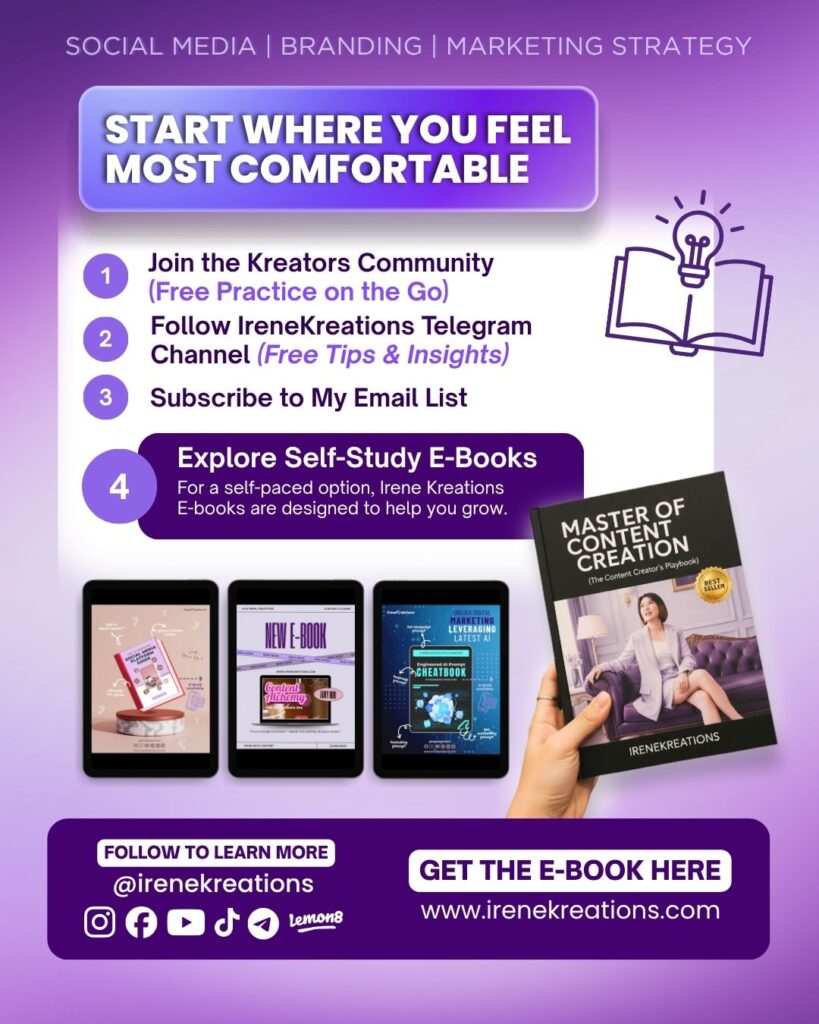
You can start in a way that feels more comfortable:
1. Join the Kreators Community (Free)
A supportive, non-transactional space where creators and business owners come together to learn, share, and grow.
It’s not about hard selling or competition — it’s more like a kampung-style environment where people:
-Exchange ideas and experiences
-Learn from Irene on the ground in a practical content creation session
-Build genuine connections with other creators & business owners
The focus is on growing together, not performing alone.
👉 [Join Kreators Community]
2. Explore Self-Study E-Books
If you prefer to process things at your own pace, IreneKreations E-books are designed to help you:
-Think clearer about your content and positioning (for a specific niche)
-Understand why you’re stuck (not just what to do)
-Build your own structure without overwhelm
👉 [Browse Growth Hacks E-Books Library]
3. Follow My Telegram Channel (Free Tips & Insights)
If you’re still observing and learning, this is a good place to start.
I regularly share:
-Practical content and branding insights
-Realtime Tips or Customer’s Proven Case Study
-Real thoughts behind strategy (not just surface tips)
-Observations from real business and creator experiences
-At times, leveraging AI for content marketing tips
👉 [Join IreneKreations Telegram Channel]
4. Subscribe to My Email List (Free Insights)
If you prefer something simple, you can join my mailing list.
This is where I share:
-Deeper breakdowns of Marketing knowledge and experience sharing
-Insights I don’t always post on social media
-Practical reflections to help you think more clearly about your direction
It’s designed for people who want steady clarity over time, not just quick tips.
👉 [Subscribe to Email List]
You don’t have to figure everything out alone.
But you also don’t have to rush your process.
Whether you prefer:
-Talking things through
-Learning at your own pace
-Getting small consistent insights
-Or simply observing for now
There’s a space for you here, built and supported by IreneKreations.