
The agents winning today are not always the ones with the biggest listings — they are the ones who can make people feel a property in under 30 seconds.
As one marketing principle often repeated by content strategists puts it:
“People don’t buy properties. They buy futures they can picture themselves in.”
And short-form video is now the fastest way to build that picture.
In an attention economy where average users scroll within 1.7–2.5 seconds before deciding to stay or leave, platforms like Instagram Reels, TikTok, and YouTube Shorts are no longer optional for property agents — they are essential distribution engines.
Reports from industry studies (including HubSpot’s State of Marketing and TikTok business insights) consistently show:
- Short-form video has the highest ROI among social media content formats
- Video posts generate significantly higher engagement than static listings
- Real estate listings with video receive substantially more inquiries than those without
In simple terms:
If your property isn’t being felt in video, it is being skipped in silence.
Short-form videos are one of the fastest ways for real estate agents to connect with potential buyers and sellers online. Platforms like Instagram Reels, TikTok, and YouTube Shorts thrive on quick, engaging, and informative content.If you’re new to video marketing, this guide will help you plan, structure, and create videos that get attention and generate leads.
1. Types of Short-Form Videos
Understanding the types of videos you can create helps you stay consistent and diversify your content. Here are 8 popular kinds for real estate professionals:
- Educational / Value – Teach something quickly.
Example: “3 tips to get your home ready for sale.” - Demonstration / Tutorial – Show a process or step-by-step guide.
Example: “How to evaluate if a property is priced right.” - Problem–Solution – Highlight a common problem and provide a solution.
Example: “Struggling to sell your house fast? Here’s how I help homeowners attract buyers quickly.” - Before–After Transformation – Show changes or improvements.
Example: “From empty apartment to staged dream home – see the difference!” - Testimonial / Social Proof – Share client success stories.
Example: “We helped this family find their dream home in just 2 weeks!” - Emotional / Relatable – Capture everyday frustrations or joys.
Example: “That feeling when you finally get the keys to your first home.” - Behind the Scenes (BTS) – Show what happens behind the scenes in your work.
Example: “A day in the life of a property agent: property tours, paperwork, and client calls.” - Promotional / Offer Highlight – Highlight services or special deals.
Example: “Free home valuation for the first 10 clients this month – DM me now!”
2. Structuring Your Videos
A good video keeps viewers hooked from start to finish. Here are two proven structures:
A) Hook → Problem → Solution → CTA
This works best for educational or problem-solving videos.
- Hook: Grab attention in the first 1–2 seconds.
Example: “Thinking of selling your home but don’t know where to start?” - Problem: Explain the pain point your audience faces.
Example: “Most homes sit on the market for months because they aren’t priced or staged correctly.” - Solution: Show how your expertise can help.
Example: “I help homeowners attract buyers fast by pricing strategically and staging effectively.” - CTA (Call to Action): Guide viewers to take action.
Example: “Message me today for a free property consultation!”
B) Hook → Opening → Peak → Ending
This storytelling format works well for emotional or transformation-driven content.
- Hook: Intrigue your audience.
Example: “Here’s how we helped a family sell their house in under a week.” - Opening: Set the scene.
Example: “They had tried multiple agents with no success and were getting frustrated.” - Peak: Show the main action or result.
Example: “We staged their home, marketed it online, and hosted an open house – the offers came flooding in.” - Ending: Close with a satisfying or emotional payoff.
Example: “They sold above asking price and are now moving into their dream home.”
(C) Problem → Empathy → Solution → CTA
Scenario: Homeowners struggling to sell in a slow market.
- Hook: “Your house has been on the market for months with no offers?”
- Empathy: “We know how frustrating it is to invest time and money and still see no results.”
- Solution: “Our strategic pricing and professional staging help homes attract buyers faster.”
- CTA: “DM me today for a free property assessment!”
(D) Teaser → Reveal
Scenario: Staged property transformation.
- Hook: “This empty condo looks ordinary… wait till you see the final look!”
- Content Flow: Show short clips of the empty space, hints of furniture being added, a fast-motion setup.
- Reveal: Show the beautifully staged apartment with wide-angle shots.
- CTA: “Ready to sell your home faster? Contact us to transform your space!”
(E) Step-by-Step / How-To
Scenario: Preparing a home for sale.
- Hook: “Want to sell your house quickly and at the best price?”
- Step 1: Declutter and clean every corner. Show before/after clips.
- Step 2: Stage key rooms like the living room and master bedroom.
- Step 3: Professional photos and listing online.
- CTA: “Follow these 3 steps and message me if you want a personalized plan!”
(F) Challenge / POV
Scenario: A busy agent managing multiple properties.
- Hook: “POV: You have 3 client showings in one afternoon.”
- Content Flow: Quick clips showing prep, keys in hand, client tours, paperwork.
- Ending: “Managing it all is tough, but the results are worth it!”
- CTA: “If you want to simplify your selling journey, let me help.”
(G) Top Tips / Listicles
Scenario: Pricing a property correctly.
- Hook: “5 pricing mistakes that could cost you thousands!”
- Tip 1: Setting the price too high.
- Tip 2: Ignoring local market trends.
- Tip 3: Forgetting seasonal timing.
- Tip 4: Not considering online exposure.
- Tip 5: Comparing only with neighbor homes.
- CTA: “Avoid these mistakes—message me for a free home valuation.”
(H) Before → During → After
Scenario: Home staging and quick sale.
- Hook: “Watch this property sell in just 7 days!”
- Before: Show cluttered rooms and empty spaces.
- During: Clips of staging process, furniture placement, decor added.
- After: Beautifully staged home, “Sold” sign outside.
- CTA: “Want your home sold fast? Let’s chat!”
(I) Reaction / Response
Scenario: Debunking a selling myth.
- Hook: “Everyone says selling in December is impossible… but that’s false.”
- Content Flow: Show stats, quick visuals of recent December sales, and personal experience.
- Ending/CTA: “The right strategy works year-round—message me to find out how.”
(J) Comparison / vs
Scenario: Selling with staging vs. without staging.
- Hook: “Staged home vs. unstaged home – which sells faster?”
- Visuals: Side-by-side clips of same rooms, one empty, one staged.
- Content Flow: Highlight buyer reaction, offers received, faster sale timeline.
- CTA: “Want to sell your home faster? Let’s stage it together!”
(K) Storytelling / Case Study
Scenario: Family struggling to sell, then successfully sold with your help.
- Hook: “Meet the Smiths—they couldn’t sell their house for months.”
- Opening: “They tried several agents, but no buyers were interested.”
- Peak: “We staged their home, optimized the listing, and held targeted open houses.”
- Ending: “Their house sold above asking price in just 10 days!”
- CTA: “Want a success story like this? Contact me today!”
(L) Behind the Numbers / Insights
Scenario: Explaining a local property trend.
–CTA: “Message me to find out how your home fits into today’s market trends!”
–Hook: “Did you know homes in District 5 sold 25% faster this year?”
–Content Flow: Show simple charts, property clips, and explain what this means for sellers/buyers.
–Ending: “The market is moving fast, and timing is key.”
3. Other Short Video Structures to Try
To keep your content fresh, experiment with these formats:
- Question → Answer – “What’s the best time to sell your property? Here’s what you need to know.”
- Myth → Reality – “Myth: You can’t sell a property in a buyer’s market. Reality: Strategic pricing works.”
- POV Style – “POV: You walk into your first open house and instantly fall in love.”
- List Format – “3 mistakes homeowners make when selling their house.”
- ASMR / Satisfying Clips – Visuals of property walkthroughs, clean spaces, or home transformations.
4. Tips for Beginners
- Keep videos short and focused – 15–60 seconds works best.
- Include a hook in the first 1–2 seconds to grab attention.
- Focus on one idea per video – don’t overwhelm viewers.
- Use captions or text overlays – many watch without sound.
- End with a CTA or emotional payoff – guide your audience to take the next step.
Short-form video can feel intimidating, but with these structures and ideas, real estate agents can create content that educates, engages, and converts. Start simple, stay consistent, and watch your audience grow!
Why Social Media Is Essential for Property Agents in 2026
Real estate used to run on location, flyers, and referrals.
Now it runs on:
- Algorithm visibility
- Personal branding
- Trust built at scale
Social media is no longer just “marketing.” It is:
- Your digital showroom
- Your credibility portfolio
- Your 24/7 lead generator
Key reality shift:
Most buyers and renters now begin their property journey online before contacting an agent.
This means your job is no longer just to sell property.
It is to:
- Capture attention
- Build trust fast
- Translate space into emotion
Short-form video does exactly that.
What Is Short-Form Video Storytelling in Real Estate?
It is not just property walkthroughs.
It is emotional micro-narratives about space.
Instead of:
- “3-bedroom condo in District 15”
You create:
- “What your morning feels like waking up here”
Instead of:
- “New listing with sea view”
You show:
- “How your evenings slow down when the sun hits this balcony”
The structure is simple:
- Hook (0–3 seconds)
- Emotional framing (what this space feels like)
- Visual storytelling (key features as scenes, not specs)
- Micro-call to action (DM, enquiry, viewing)
Positivity & Investment Tips as a Strategic Content Pillar
For example, for property agents and real estate investment advisors, Positivity & Investment Tips provide the perfect balance between relatability and authority. By addressing specific, high-intent questions, your brand positions itself as a trusted guide, showing expertise at the exact moment prospects are evaluating property investment options.
Examples of strategic search questions include:
- “Is now a good time to invest in Singapore property?”
- “How can I start property investment with a small budget?”
- “What are the common mistakes new investors make?”
- “Which neighborhoods in Singapore have the best long-term growth potential?”
- “How do I stay confident during property market fluctuations?”
By answering these questions first, agents capture attention before competitors, build credibility, and create a pathway for higher investment confidence.
High-performing hook styles:
- “Most people miss this part of this home…”
- “If I was buying my first home, I would look at THIS…”
- “This is what $X,000/month actually feels like…”
- “Not many agents will show you this angle…”
This is where attention is won or lost.

Topics Derived from FAQ SEO (AEO)
Using a question-led, AEO-focused approach, blog topics for property investment can be strategically created:
- “5 Rookie Mistakes New Property Investors Make—and How to Avoid Them”
- “Why Patience and Positivity Can Boost Your Investment Returns”
- “Top 7 Singapore Neighborhoods With High Property Growth Potential in 2026”
- “The Hidden Costs of Buying Property Without a Strategy—and What Works Instead”
- “How a Positive Mindset Helps You Navigate Market Fluctuations”
- “Starting Property Investment With a Small Budget: A Practical Guide for Beginners”
These topics not only attract readers but are structured for search engines, helping your brand appear in “People Also Ask” and other high-value search features.
Social Media Content Ideas
These Social Media Content Ideas are designed to answer questions in bite-sized formats:
Carousel 1:
- Title: “3 Mindset Shifts Every Property Investor Needs”
Slides: Common worry → Insight from market trends → Practical tip → CTA
Carousel 2:
- Title: “Why Many New Investors Fail—and How to Avoid It”
Slides: Typical mistake → Strategic insight → Step-by-step action → CTA
Carousel 3:
- Title: “How to Identify High-Growth Properties in Singapore”
Slides: Problem → Market analysis → Practical checklist → CTA
Carousel 4:
- Title: “Shorten Your Investment Learning Curve With Smart Tips”
Slides: Step-by-step guide using FAQs, actionable advice, and success examples
Storytelling Angles That Work for Property Agents
Instead of listing features, shift into narrative frames:
1. Lifestyle Lens
- “A morning routine in this space”
- “After-work life here feels like…”
2. Problem-Solution Lens
- “Tired of cramped layouts? This solves it.”
- “If storage is your biggest issue, watch this…”
3. Emotional Identity Lens
- “For young couples building their first home”
- “For professionals who want calm after work”
4. Curiosity Gap Lens
- “There is one feature in this unit most people overlook…”
Common Mistakes Property Agents Make on Social Media
1. Over-focusing on specs instead of emotion
People don’t remember square footage. They remember how it felt.
2. Treating every video like a listing sheet
Short-form content is not a brochure. It is a story.
3. Inconsistent posting
Algorithms reward consistency more than perfection.
4. Lack of brand identity
Without visual consistency, agents become interchangeable.

The most common questions business owners are asking online
Q: How can I DIY my social media content in Singapore without hiring an agency?
A: DIY content only works well when it becomes a system, not daily improvisation.
A practical approach:
-Learn your core content types
-Define brand pillars so you are not guessing topics every day
-Use AI with structured prompts, not random ideas or trend copying
-Build repeatable formats (hooks, breakdowns, CTA styles)
-Focus on consistency, not perfection
Q: Why do my Reels get 0 views?
A: There may be a glitch, because even for non-viral or low engagement content, public accounts usually still receive at least a few to around 100 views as a baseline. This low-engagement usually isn’t random or “bad luck”—it’s the algorithm along with a clarity signal issue.
Most 0-view Reels happen because the platform cannot confidently categorise your content or test it with the right audience. Common causes:
-No clear topic consistency (each Reel feels unrelated)
-Weak or missing hook in the first 1–2 seconds
-Broad messaging that doesn’t signal who it’s for
-Low early engagement signals (no watch time, saves, or replays)
In simple terms: the system doesn’t know who to show you to, so it doesn’t push it further.
Q: How do I get my Reels to reach Singapore Audience?
You don’t “target Singapore” by saying it—you signal it through content patterns.
What works:
-Local context: Singapore-specific situations, habits, or pain points
-Language tone: conversational, practical, slightly direct communication style
-Relatable scenarios: business owners, pricing, customer behaviour, or lifestyle patterns in SG
-Consistent niche signals: repeated themes so the algorithm classifies your audience properly
The platform distributes content based on behaviour patterns—not intent.
Q: How many Reels should I post to grow?
Posting frequency alone does not create growth. What matters more:
-Clear positioning (what your account is known for)
-Strong hooks (why someone should stop scrolling)
-Repeatable content structure (so the system learns your niche)
You can post 1 strong, clear Reel and outperform 10 inconsistent ones. Growth comes from pattern clarity, not volume.
Q: How do I make educational videos less boring?
A: Focus on structure, not performance. Most “boring” educational content fails because it starts with explanation instead of attention.
Try using this flow instead:
-Tension hook (a problem they already feel)
-Simple breakdown (1 idea at a time, not everything at once)
-Relatable situation (show where this shows up in real life)
-Clear takeaway (what they should do or think differently)
Make it feel like you’re solving confusion, not delivering a lecture.
Q: Why are my educational videos not converting?
A: One of the reasons could be your video informs—but doesn’t guide decisions or build trust.
Information alone doesn’t convert. What converts is:
-Clarity (they finally “get it”)
-Relevance (they feel “this is me”)
-Direction (they know what to do next)
If your content stops at explaining, people learn but don’t act. If it helps them decide, it converts.
Q: What makes content trustworthy in the Singapore market?
A: Trust here is not built through hype or personality alone—it’s built through consistency signals.
Key drivers:
-Consistency: same tone, message, and visual direction over time
-Clarity: no overcomplication, no vague messaging
-Emotional tone awareness: calm, grounded communication tends to outperform overly loud persuasion
Q: Why do my competitors get more views?
A: In most cases, it’s not that their content is “better”—it’s that it’s easier to classify and distribute. Typical advantages they have:
-Stronger hooks that immediately define relevance
-Clear niche positioning (the algorithm knows exactly who to show it to)
-Repetitive content themes that train audience recognition
-More consistent engagement history (which builds distribution confidence)
Q: Can I use the same export for Instagram and TikTok?
A: Technically yes, but strategically not ideal.
Both platforms use vertical video, but they differ in how content is processed and surfaced.
TikTok prioritises raw engagement signals and early watch behaviour
Instagram Reels leans more into aesthetic consistency and account history
Using the same export can work, but you risk one platform being slightly under-optimised. Ideally, you adjust minor elements (text placement, safe zones, caption framing) so nothing gets cropped or visually weakened on either platform.
Q: What’s the best file type for all platforms?
A: MP4 (H.264 codec) is the most reliable universal format.
It is widely supported because it balances:
-Good visual quality
-Manageable file size
-Stable compatibility across Instagram, TikTok, Facebook, and most web systems
Other formats may be accepted, but MP4 is the safest standard for consistent delivery.
Q: How do I keep text readable on mobile?
A: Mobile readability is not just about font size—it’s about visual hierarchy and spacing.
Key technical + design considerations:
-Export in 1080 × 1920 (9:16 vertical format)
-Use minimum ~24pt font equivalent (larger if the video is information-heavy)
-Avoid placing text near screen edges (safe zone awareness)
-Maintain strong contrast between text and background
-Always preview on an actual phone, not just desktop editing software
If viewers have to “work” to read your content, retention drops immediately.
Conclusion
Short-form video is no longer just a marketing tool for property agents — it is the new language of trust, attention, and emotional decision-making.
The agents who learn to tell better stories will not just sell more properties — they will build stronger personal brands that outlast market cycles.
And as social media continues to evolve, the real question is no longer whether you should show up online…
It is whether your audience can feel your story clearly enough to choose you when it matters most — are you ready to start telling it?
✧⭒✦✧⭒✦◇ Get Social Media | Branding | Marketing | Content Strategy Support in Singapore ✦⭒✧✦⭒✧
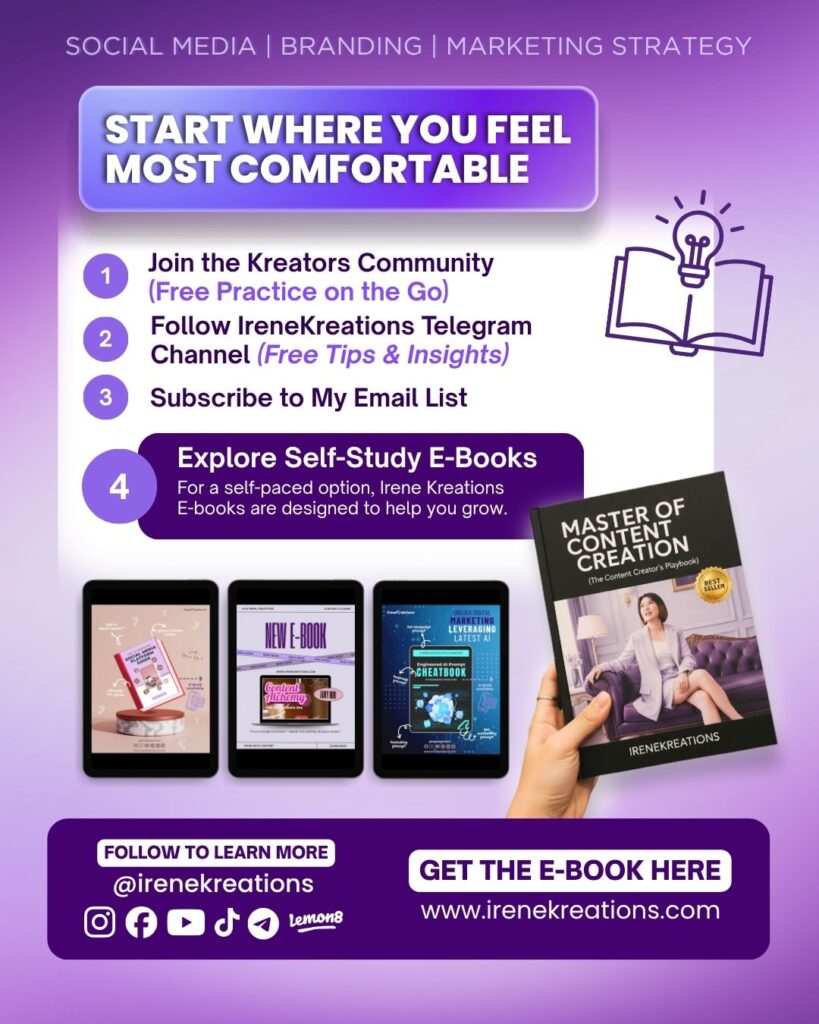
You can start in a way that feels more comfortable:
1. Join the Kreators Community (Free)
A supportive, non-transactional space where creators and business owners come together to learn, share, and grow.
It’s not about hard selling or competition — it’s more like a kampung-style environment where people:
-Exchange ideas and experiences
-Learn from Irene on the ground in a practical content creation session
-Build genuine connections with other creators & business owners
The focus is on growing together, not performing alone.
👉 [Join Kreators Community]
2. Explore Self-Study E-Books
If you prefer to process things at your own pace, IreneKreations E-books are designed to help you:
-Think clearer about your content and positioning (for a specific niche)
-Understand why you’re stuck (not just what to do)
-Build your own structure without overwhelm
👉 [Browse Growth Hacks E-Books Library]
3. Follow My Telegram Channel (Free Tips & Insights)
If you’re still observing and learning, this is a good place to start.
I regularly share:
-Practical content and branding insights
-Realtime Tips or Customer’s Proven Case Study
-Real thoughts behind strategy (not just surface tips)
-Observations from real business and creator experiences
-At times, leveraging AI for content marketing tips
👉 [Join IreneKreations Telegram Channel]
4. Subscribe to My Email List (Free Insights)
If you prefer something simple, you can join my mailing list.
This is where I share:
-Deeper breakdowns of Marketing knowledge and experience sharing
-Insights I don’t always post on social media
-Practical reflections to help you think more clearly about your direction
It’s designed for people who want steady clarity over time, not just quick tips.
👉 [Subscribe to Email List]
You don’t have to figure everything out alone.
But you also don’t have to rush your process.
Whether you prefer:
-Talking things through
-Learning at your own pace
-Getting small consistent insights
-Or simply observing for now
There’s a space for you here, built and supported by IreneKreations.