AI is supposed to make marketing easier… but why does it feel like it’s doing everything but that? You know it could save you time… if only you knew how to make it work. For many business owners, DIY-ing AI prompts feels like solving a puzzle you didn’t ask for. Inconsistency is often an identity problem, not a skill problem.
At IreneKreations, we help business owners cut through the confusion and build clarity first—so AI becomes a helpful assistant, not a source of stress. Here’s a practical guide on prompting better for your marketing, why most courses won’t teach the nuances you need, and how our approach helps you create with confidence.
The Problem: DIY AI Often Feels Harder Than Helpful
Small business owners in Singapore are embracing AI tools for marketing, content, and social media. Yet, despite access to ChatGPT, MidJourney, and other creative AI platforms, many report:
- AI outputs are inconsistent
- Instructions have to be repeated multiple times
- Results feel generic or “off-brand”
- Tools overwhelm more than they simplify
Why? Most courses focus on what tools to use, not how to think, see, and decide about content, branding, and messaging. This leaves business owners with skills gaps in:
- Strategic content clarity
- Brand-aligned messaging
- AI prompt reasoning and intent
As seen on some articles on ST, many Singapore SMEs struggle with digital content production despite AI adoption.
AI tools are everywhere—but results are still wildly inconsistent.
One person gets cinematic videos, high-converting copy, and on-brand visuals.
Another gets generic output, broken motion, or text that “almost works.”
The difference isn’t the tool.
It’s prompting skill.
At IreneKreations, we see the same problem across creators, entrepreneurs, and small businesses:
They use AI—but they don’t direct it.
How to Prompt Better for Marketing: Human-First, Not Tool-First
Prompting isn’t about memorizing wordings, symbols or brackets. It’s about clear communication. Here’s the framework we teach our clients:
(1) Start with Clarity: Define Your Goal
Ask yourself: “What do I want AI to do?”
- Example: “Write a blog post that educates my audience on stress-free event planning.”
- Avoid: “Write something marketing-y” — too vague.
(2) Break It Down Into Action + Context
Use simple instructions:
- Action: explain, compare, summarize
- Context: target audience, purpose, tone
Example:
Explain social media tips for [beginner business owners in Singapore] who feel overwhelmed by [AI].
Use clear, human language, not jargon.
(3) Prioritize What Matters
Business owners often overcomplicate prompts, adding everything at once. Instead, highlight priorities explicitly:
- “Focus on clarity and step-by-step workflow.”
- “Emphasize brand alignment, not trendy tools.”
(4) Specify Format and Style
Formatting reduces rework and confusion.
- “Provide 3 bullet points, each under 50 words.”
- “Write as a friendly advisor, not a marketer.”
- “Include examples relevant to Singapore SMEs.”
(5) Avoid Relying on Symbols
Brackets ( ), [ ], { }—often marketed as “weighting shortcuts”—do not control emphasis in text-based AI like ChatGPT. They only work in some image-generation tools, and even then inconsistently. Focus on words, ordering, and repetition to guide attention.
AI Text vs Image vs Video Prompting (What Changes)
Text AI (ChatGPT, Claude, Gemini)
- Brackets do not add emphasis
- Symbols do not carry percentages
- Structure, priority, and language matter
✅ What works:
- “Primary goal:”
- “Do not include:”
- “Audience: beginners”
- Clear output formats
❌ What doesn’t:
(important)[[very important]]{!!!}
Image AI (Stable Diffusion–style tools)
- Brackets may apply weighting
(word)can increase emphasis[word]can reduce importance(word:1.3)is explicit weighting
This only works if the tool documents it
Video AI (Runway, Pika, Luma, Sora-style)
This is where most people fail.
Video prompting requires:
- time
- motion
- camera direction
- consistency
If you don’t describe movement, the model guesses.
Why Courses Don’t Solve This
Most online courses, even paid ones, show you:
- Which AI tool to use
- How to input prompts
- Step-by-step “hacky” outputs
But they skip the foundation:
- How to think about brand voice and consistency
- How to plan content that aligns with long-term credibility
- How to use AI as a workflow helper rather than a crutch
Courses teach tool tricks, not thought processes. That’s why DIY attempts often fail.
How IreneKreations Helps
| Still unsure what to create and why your content doesn’t feel like your brand? Here’s how IreneKreations turns that confusion into a clear, structured system that finally makes your visuals work for you. Many business owners don’t struggle because they lack tools—they struggle because they don’t know how to translate their brand into clear visual direction. Even with AI tools, many end up generating content that looks “nice” but still doesn’t represent their brand well, simply because they’re unsure what to prompt, what style works, or what visual direction to take. Through coaching and consultation, IreneKreations helps business owners move from confusion to clarity: 1. Brand Clarity First 🧭Defining identity, tone, audience, and positioning before any visual or content decisions are made. 2. Visual Decision Framework 🎯Understanding when to use AI, when to use real photography, and the purpose behind each choice. 3. Practical, Real-World Systems ⚙️Building simple, workable content systems that fit into their time, energy, and available resources. 4. Alignment Over Trends 🌿Creating visuals and content that stay consistent with the brand, instead of chasing what’s currently trending. 5. Confidence in Prompting Creation 💡Helping business owners move from uncertainty and guesswork to confident, intentional prompting and clear decision-making in their content creation process. |
Must-Have Skills for AI Marketing Success
- Strategic Clarity – Know what you want to achieve before writing a prompt
- Audience Understanding – Tailor tone, style, and complexity
- Priority Highlighting – Use clear language to guide AI attention
- Iteration Mindset – Refine outputs step-by-step, don’t expect perfection on the first try
- Brand Alignment – Evaluate if AI outputs reflect your brand’s personality, not just your instructions
Bonus: Common Misunderstandings About AI Prompts
- Symbols don’t equal emphasis:
( )or[ ]won’t magically improve text results - Long prompts aren’t always better: clarity beats length
- AI is not intuitive: it can’t infer brand identity unless you define it
Think of AI as a helpful assistant, not a replacement for strategic thinking.
Business owners also asked online
Q: How can AI be used without losing brand authenticity?
AI should operate as an execution layer, not a decision-maker.
To maintain authenticity:
-Brand direction (tone, values, audience) must be defined first
-AI is used to scale output, not define identity
-Human judgment remains the final filter for tone and relevance
Without this structure, AI tends to produce “statistically correct but emotionally flat” content that lacks identity consistency.
Q: How do I know if my content is aligned with my brand?
A: Check for repeatability and recognition.
Ask:
-Does it sound like me without forcing it?
-Would the same audience consistently recognise this style?
-Does it feel natural to repeat weekly without exhaustion?
-Does it attract the right people, not just more people?
If your content only works when you “try hard,” it’s not aligned yet. If it feels natural but still intentional, you’re close to alignment.
Q: Can AI replace human brand strategy?
A: No. AI can support:
-Idea generation
-Content drafting
-Variations and optimisation
But it cannot replace:
-Brand positioning decisions
-Tone and voice definition
-Audience emotional understanding
-Strategic judgment on what should not be said
AI executes structure. Humans define meaning.
Q: Where can Singapore business owners learn practical AI content skills?
Beyond theory-heavy courses, practical learning comes from applied systems. At IreneKreations, the focus is on helping business owners:
-Build brand-aligned content workflows
-Create usable AI prompts (not just templates) — and build an endless content ecosystem that keeps generating aligned ideas, not random outputs.
-Understand how to structure messaging for real audiences
-Save time by systemising content instead of improvising every time
Q: Are AI-generated images good for business use?
Yes, when used intentionally. They are best for conceptual visuals, supplementary content, and creative exploration—not as the sole representation of a brand.
Q: Do customers trust AI images?
Trust really depends on context. In many situations, real images of people, products, or environments tend to build stronger credibility than AI visuals alone.
That said, I do also see AI-generated visuals that are real scroll-stoppers—highly creative, visually striking, and conceptually unique. The impact really comes down to having strong ideas and the ability to prompt clearly and precisely to get the intended result.
Q: What is the risk of relying too much on AI visuals?
If you rely on generic prompts or a simple question-and-answer approach, you’ll likely end up with generic results that aren’t very useful or usable.
Over-reliance can also lead to bland or dilute branding, reduced trust, and inconsistency—especially when the visuals don’t align with your brand’s voice, positioning, and overall identity.
Bottom Line
Marketing with AI shouldn’t feel like learning rocket science—but it often does. The difference between chaos and clarity isn’t the tool—it’s the strategy and thought behind it.
At IreneKreations, we guide business owners back to clarity, so AI becomes a helper, not a puzzle. Our coaching focuses on thinking, seeing, and deciding, not just “press this button.”
Marketing should be creative, not a battle with prompts and settings. Let’s make AI work for you.
✧⭒✦✧⭒✦◇ Get Social Media | Branding | Marketing | Content Strategy Support in Singapore ✦⭒✧✦⭒✧
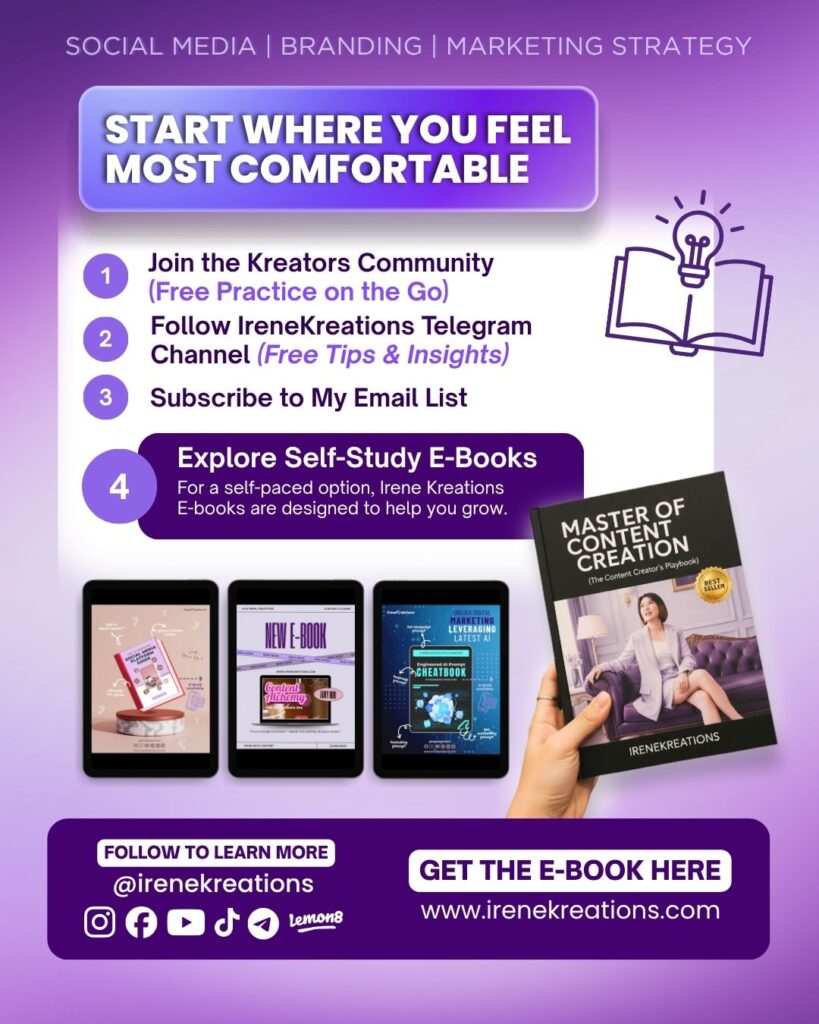
You can start in a way that feels more comfortable:
1. Join the Kreators Community (Free)
A supportive, non-transactional space where creators and business owners come together to learn, share, and grow.
It’s not about hard selling or competition — it’s more like a kampung-style environment where people:
-Exchange ideas and experiences
-Learn from Irene on the ground in a practical content creation session
-Build genuine connections with other creators & business owners
The focus is on growing together, not performing alone.
👉 [Join Kreators Community]
2. Explore Self-Study E-Books
If you prefer to process things at your own pace, IreneKreations E-books are designed to help you:
-Think clearer about your content and positioning (for a specific niche)
-Understand why you’re stuck (not just what to do)
-Build your own structure without overwhelm
👉 [Browse Growth Hacks E-Books Library]
3. Follow My Telegram Channel (Free Tips & Insights)
If you’re still observing and learning, this is a good place to start.
I regularly share:
-Practical content and branding insights
-Realtime Tips or Customer’s Proven Case Study
-Real thoughts behind strategy (not just surface tips)
-Observations from real business and creator experiences
-At times, leveraging AI for content marketing tips
👉 [Join IreneKreations Telegram Channel]
4. Subscribe to My Email List (Free Insights)
If you prefer something simple, you can join my mailing list.
This is where I share:
-Deeper breakdowns of Marketing knowledge and experience sharing
-Insights I don’t always post on social media
-Practical reflections to help you think more clearly about your direction
It’s designed for people who want steady clarity over time, not just quick tips.
👉 [Subscribe to Email List]
You don’t have to figure everything out alone.
But you also don’t have to rush your process.
Whether you prefer:
-Talking things through
-Learning at your own pace
-Getting small consistent insights
-Or simply observing for now
There’s a space for you here, built and supported by IreneKreations.