“Having values doesn’t automatically make a brand.”
That’s the truth most business owners learn too late.
You may have a mission, values, and a message you truly believe in — but when you try to write content, especially with AI, the output often feels like it’s missing you. It sounds generic. It doesn’t reflect your brand voice. And most importantly, it doesn’t connect with your customers.
If you’ve ever felt like AI is “almost there” but not quite, you’re not alone.
And here’s the deeper reason: you’re trying to generate content without understanding what kind of content you actually need.
The Real Problem: Inconsistency Is Often An Identity Problem, Not A Skill Problem
Many business owners believe they’re bad at writing, or they just don’t have the time. But the real issue is not skill — it’s clarity.
Without knowing the types of writing you need, your AI prompts become random and inconsistent. The result is content that looks like it was written by “someone else,” not by your brand.
Here’s what IreneKreations helps you solve:
- You want to DIY your content but you don’t know what type of writing works best.
- You try AI but it gives you generic, disconnected results.
- You want to build a brand voice that feels authentic — not fake.
- You want to create content without relying on agencies or freelancers.
And this is why understanding writing types matters.
10% of Your Content Strategy Should Be About Knowing Writing Types Before Prompting
When you know what type of paragraph or content you need, AI becomes a tool — not a guessing game.
Here’s what happens when you understand writing types:
- Your AI prompts become precise
- Your content becomes consistent
- Your brand voice becomes recognizable
- Your audience starts trusting you faster
- Your buyer journey shortens
Because when you know what you want, AI can deliver it.

The Content Types That Make DIY Marketing Work
Below are the core writing types that should be in your content strategy. These are the real building blocks that will make your brand feel cohesive, confident, and credible.
1. Problem Framing Content
This type of writing explains the pain point clearly.
Example: “Why your content doesn’t convert even though it looks pretty.”
2. Empathy Validation Content
This type of writing acknowledges the audience’s struggle.
Example: “It’s normal to feel stuck — you’re not alone.”
3. Authority Content
This includes stats, expertise, and credible frameworks.
Example: “The content formula that actually builds trust.”
4. Educational / How-To Content
This helps your audience learn without relying on you.
Example: “How to plan a month’s worth of content in 30 minutes.”
5. Comparison Content
This helps them decide between options.
Example: “DIY vs Agency vs Freelancer: Which is best for you?”
6. Conversion Content
This type guides them toward the next step without pressure.
Example: “If you want consistency, this is the next step.”
Most business owners make this mistake:
They prompt AI with a vague request like:
“Write a social media caption about my brand.”
AI then outputs something generic because it doesn’t know the type of writing you want.
But if you prompt with a specific content type, you get better results.
Example:
“Write an empathy validation paragraph for a business owner who feels lost with AI content.”
Now AI understands the intent.

The information people are actively seeking clarity on
Q: How can I DIY my social media content in Singapore without hiring an agency?
A: DIY content only works well when it becomes a system, not daily improvisation.
A practical approach:
-Learn your core content types
-Define brand pillars so you are not guessing topics every day
-Use AI with structured prompts, not random ideas or trend copying
-Build repeatable formats (hooks, breakdowns, CTA styles)
-Focus on consistency, not perfection
Q: Why do my Reels get 0 views?
A: There may be a glitch, because even for non-viral or low engagement content, public accounts usually still receive at least a few to around 100 views as a baseline. This low-engagement usually isn’t random or “bad luck”—it’s the algorithm along with a clarity signal issue. Most 0-view Reels happen because the platform cannot confidently categorise your content or test it with the right audience. Common causes:
-No clear topic consistency (each Reel feels unrelated)
-Weak or missing hook in the first 1–2 seconds
-Broad messaging that doesn’t signal who it’s for
-Low early engagement signals (no watch time, saves, or replays)
In simple terms: the system doesn’t know who to show you to, so it doesn’t push it further.
Q: How do I get my Reels to reach Singapore Audience?
You don’t “target Singapore” by saying it—you signal it through content patterns.
What works:
-Local context: Singapore-specific situations, habits, or pain points
-Language tone: conversational, practical, slightly direct communication style
-Relatable scenarios: business owners, pricing, customer behaviour, or lifestyle patterns in SG
-Consistent niche signals: repeated themes so the algorithm classifies your audience properly
The platform distributes content based on behaviour patterns—not intent.
Q: How many Reels should I post to grow?
Posting frequency alone does not create growth. What matters more:
-Clear positioning (what your account is known for)
-Strong hooks (why someone should stop scrolling)
-Repeatable content structure (so the system learns your niche)
You can post 1 strong, clear Reel and outperform 10 inconsistent ones. Growth comes from pattern clarity, not volume.
Q: How do I make educational videos less boring?
A: Focus on structure, not performance. Most “boring” educational content fails because it starts with explanation instead of attention.
Try using this flow instead:
-Tension hook (a problem they already feel)
-Simple breakdown (1 idea at a time, not everything at once)
-Relatable situation (show where this shows up in real life)
-Clear takeaway (what they should do or think differently)
Make it feel like you’re solving confusion, not delivering a lecture.
Q: Why are my educational videos not converting?
A: One of the reasons could be your video informs—but doesn’t guide decisions or build trust.
Information alone doesn’t convert. What converts is:
-Clarity (they finally “get it”)
-Relevance (they feel “this is me”)
-Direction (they know what to do next)
If your content stops at explaining, people learn but don’t act. If it helps them decide, it converts.
Q: What makes content trustworthy in the Singapore market?
A: Trust here is not built through hype or personality alone—it’s built through consistency signals.
Key drivers:
-Consistency: same tone, message, and visual direction over time
-Clarity: no overcomplication, no vague messaging
-Emotional tone awareness: calm, grounded communication tends to outperform overly loud persuasion
How IreneKreations Helps You Build a Brand Without Losing Your Voice
Here’s the main value IreneKreations offers:
- You don’t need to hire an agency.
- You don’t need to struggle over writing too generic AI writings.
- You don’t need to spend hours figuring out content.
You only need:
- A clear brand identity
- A content framework
- The right prompts and structure
- Consistent practice
And that’s exactly what IreneKreations teaches.

Conclusion
“Slow growth at times can feels wrong in a world obsessed with speed.”
But growth that comes from inconsistent content is even worse. It wastes your time, dilutes your brand, and confuses your audience.
If marketing feels fake, it’s because you’re using someone else’s voice.
The fastest way to fix that is not to work harder — it’s to understand what type of content you need, and then learn how to prompt AI to create it.
That’s how you build a brand that feels real, consistent, and memorable.
✧⭒✦✧⭒✦◇ Get Social Media | Branding | Marketing | Content Strategy Support in Singapore ✦⭒✧✦⭒✧
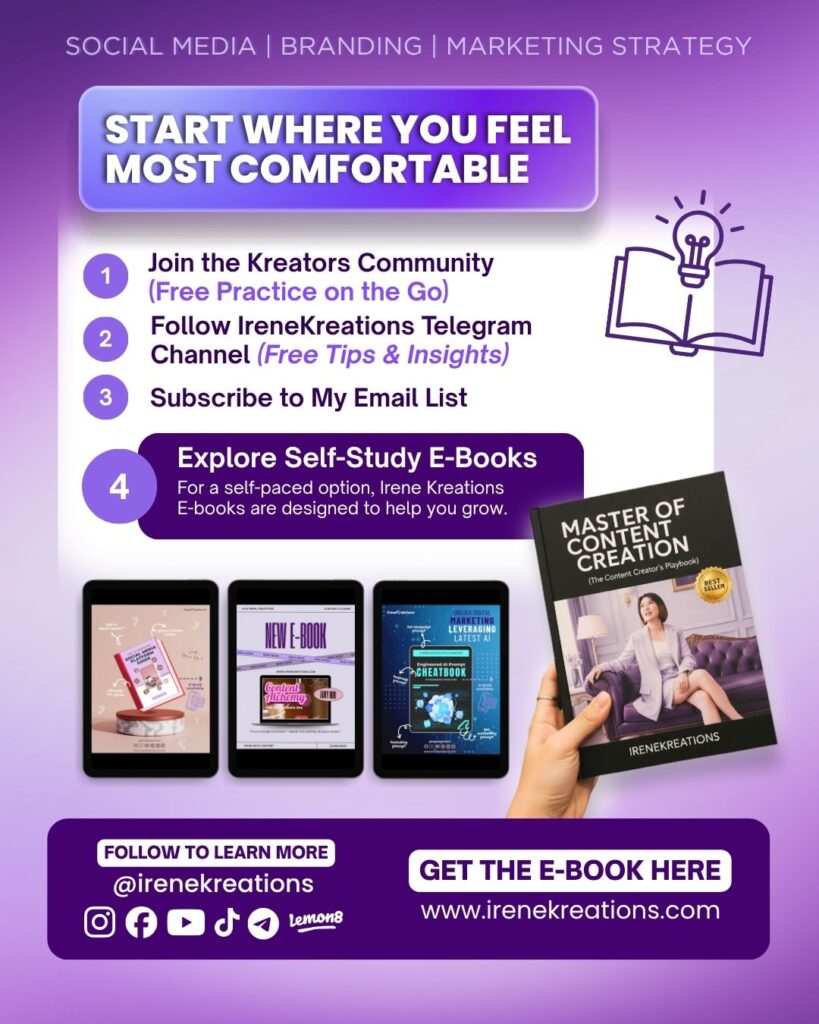
You can start in a way that feels more comfortable:
1. Join the Kreators Community (Free)
A supportive, non-transactional space where creators and business owners come together to learn, share, and grow.
It’s not about hard selling or competition — it’s more like a kampung-style environment where people:
-Exchange ideas and experiences
-Learn from Irene on the ground in a practical content creation session
-Build genuine connections with other creators & business owners
The focus is on growing together, not performing alone.
👉 [Join Kreators Community]
2. Explore Self-Study E-Books
If you prefer to process things at your own pace, IreneKreations E-books are designed to help you:
-Think clearer about your content and positioning (for a specific niche)
-Understand why you’re stuck (not just what to do)
-Build your own structure without overwhelm
👉 [Browse Growth Hacks E-Books Library]
3. Follow My Telegram Channel (Free Tips & Insights)
If you’re still observing and learning, this is a good place to start.
I regularly share:
-Practical content and branding insights
-Realtime Tips or Customer’s Proven Case Study
-Real thoughts behind strategy (not just surface tips)
-Observations from real business and creator experiences
-At times, leveraging AI for content marketing tips
👉 [Join IreneKreations Telegram Channel]
4. Subscribe to My Email List (Free Insights)
If you prefer something simple, you can join my mailing list.
This is where I share:
-Deeper breakdowns of Marketing knowledge and experience sharing
-Insights I don’t always post on social media
-Practical reflections to help you think more clearly about your direction
It’s designed for people who want steady clarity over time, not just quick tips.
👉 [Subscribe to Email List]
You don’t have to figure everything out alone.
But you also don’t have to rush your process.
Whether you prefer:
-Talking things through
-Learning at your own pace
-Getting small consistent insights
-Or simply observing for now
There’s a space for you here, built and supported by IreneKreations.