Some social media platforms are easier to grow on, while others are widely known to be more challenging for creators and business owners—one of them being Rednote. That said, everyone starts somewhere and learns along the way. I went through the same process.
At one point, I was landing campaigns but struggling with low engagement on certain posts. It’s difficult to justify performance to brands when results are heavily influenced by an unpredictable algorithm. So I started exploring what else I could control.
One approach that helped was sharing content into interest-based groups on Rednote. If you didn’t know, that feature exists. It works somewhat like the older Facebook strategy—when your page reach is limited, distributing content into relevant groups can help amplify visibility more effectively.
Of course, there’s always the option of sponsored ads—but that’s a separate conversation.
If your content isn’t getting traction on Rednote, it’s rarely just the algorithm. More often, it’s how the content is structured and positioned.
Campaign content, in particular, can be tricky. There are always mandatory elements from the brand—key messages, promotions, deliverables—that need to be included. That limits how much you can optimise purely for performance. It ends up feeling like you’re stuck in the middle: one side pushing for promotional clarity, the other side (the platform) deprioritising overly promotional posts.
For businesses, strict brand guidelines can also work against reach. When content becomes too controlled, it often loses the intent, clarity, and value that platforms prioritise for distribution.
For creators, it’s slightly easier. A third-person or experience-based POV tends to perform better because it feels more organic and less like a direct sell.
That said, it’s not just about positioning. Execution matters too—your text hook, call-to-action, visual engagement, and overall composition all play a role. Sometimes, it’s as simple as a cover that isn’t immediately clear or compelling enough to stop someone from scrolling. Triggered curiousity to click.
At IreneKreations, we see this pattern repeatedly:
business owners post consistently, but they’re still guessing how to be seen.

The Real Problem: You’re Posting Without Amplification
Most business owners think:
“If I post good content, it should perform.”
That’s incomplete.
On platforms like Rednote, distribution matters as much as creation.
🔑 The truth:
- Content = visibility potential
- Amplification = actual reach
Without amplification, even strong content gets buried.
So let’s get into one tactic that can make a difference—sharing your notes to groups:
What Is “Sharing Notes to Groups” on Rednote?
“Sharing notes to groups” means distributing your post into interest-based communities inside Rednote, where users are already actively engaging around a topic.
Think of it as:
👉 Instead of waiting to be discovered
👉 You place your content where attention already exists
Why Group Sharing Works (And Most People Miss It)
1. You bypass cold discovery ❄️
Instead of relying only on the algorithm, you tap into warm audiences already searching or browsing.
2. You match search intent faster 🔍
Groups are often built around:
- Food recommendations
- Skincare routines
- Travel guides
- Business insights
Your content becomes contextually relevant instantly.
3. You trigger early engagement signals 🚀
More saves, clicks, and comments → stronger algorithm push.
How to Use Group Sharing Properly (Not Spammy)
Most people do this wrong.
They:
- Drop links everywhere ❌
- Don’t align content with group intent ❌
- Get ignored or muted ❌

Instead, follow this system:
Step 1: Match Content to Group Intent
Ask:
- Is this group looking for inspiration, reviews, or education?
Example:
- Food group → “Top 3 underrated cafés in Tanjong Pagar”
- Business group → “Why your content isn’t converting”
Step 2: Position Your Note as a Contribution 🤝
Not:
“Check out my post”
But:
“I tested 3 cafés this week, here’s what stood out…”
This builds trust before traffic.
Step 3: Use Curiosity Hooks (Not Clickbait)
Rednote rewards:
- Experience-based content
- Honest breakdowns
- Relatable observations
Step 4: Timing Matters ⏰
Share when groups are active:
- Lunch (12–2pm)
- Night scroll (9–11pm)
Step 5: Observe What Gets Saved 📌
Saves > Likes on Rednote.
Track:
- Which posts get bookmarked
- Which formats repeat
That’s your amplification signal.
What Most Business Owners Get Wrong
This is where IreneKreations pushes back a bit.
You don’t have a “reach problem.”
You have a clarity problem.
❗ Common issues:
- Content looks nice but lacks direction
- Messaging doesn’t reflect brand identity
- Trying to follow trends without foundation
IreneKreations Approach: Why It Works Differently
We don’t start with:
“What should you post?”
We start with:
“Who are you, and what should your brand feel like?”
Here’s what we do differently:
1. Brand Essence Before Content 🎯
We define:
- Your voice
- Your positioning
- Your emotional tone
So your content becomes consistent naturally.
2. Build Credibility, Not Just Visibility 🧠
We optimise for:
- Trust
- Authority
- Long-term brand recall
Not vanity metrics.
3. Emotional Alignment Matters ❤️
Your content should feel:
- Safe
- Clear
- Intentional
Not confusing or forced.
4. Realistic Systems (No Burnout) ⚙️
We design workflows you can sustain:
- Repeatable formats
- Clear content pillars
- Efficient creation loops
5. Pre-Trend Insight 🔍
We test quietly before trends explode, so you:
- Stay ahead
- Avoid noise
What people are attempting to clarify through search:
Q: What type of content performs best on Rednote Social Media?
A: High-performing content tends to be experience-led and search-aligned, not sales-led.
Strong formats include:
-Authentic personal stories (real usage, real outcomes)
-Visual lifestyle documentation
-Honest reviews and comparisons
-Step-by-step tutorials or guides
-“Before/after” or transformation-based content
The key is not persuasion—it is relatability + usefulness + trust building.
Q: How do I find keywords for Rednote content?
A: Keyword discovery is based on observing how users naturally search.
Effective methods:
-Auto-suggestions in search bar
-Trending topic clusters within your niche
-Common questions from comments or DMs
-Competitor posts that are repeatedly discovered
-Real-world language customers use (not marketing terms)
The most powerful keywords are often user language, not industry language.
Q: How can Singapore small businesses use Rednote effectively?
A: Effectiveness comes from localisation + relatability.
Key approach:
-Use Singapore-specific context (lifestyle, pricing expectations, habits)
-Share real experiences instead of polished advertising
-Align content with how users actually search and compare options
-Focus on trust-building content over direct conversion posts
In this market, credibility grows through consistency of lived experience sharing.
Q: What is content amplification on Rednote?
A: Content amplification is the intentional process of increasing discoverability and reach—not by luck, but by aligning your content with how the platform distributes information.
On Rednote-style platforms, amplification is driven by three layers:
-Search visibility (keywords, captions, relevance)
-Initial distribution (how your content gets its first traction)
-Engagement signals (saves, shares, comments, completion rate)
It’s not just about posting—it’s about making sure your content is findable, relatable, and worth interacting with.
Q: Does sharing my content to Social media groups really help?
Yes—but only when used strategically.
Group sharing helps by:
-accelerating initial visibility
-generating early engagement signals (likes, saves, comments)
-helping the platform “test” your content faster
However, it only works if:
-the group is relevant to your content topic
-your post already has a clear hook and value
If the content is weak or misaligned, sharing more won’t fix performance—it just amplifies the same issue.
I’ve Created a Foodie Group
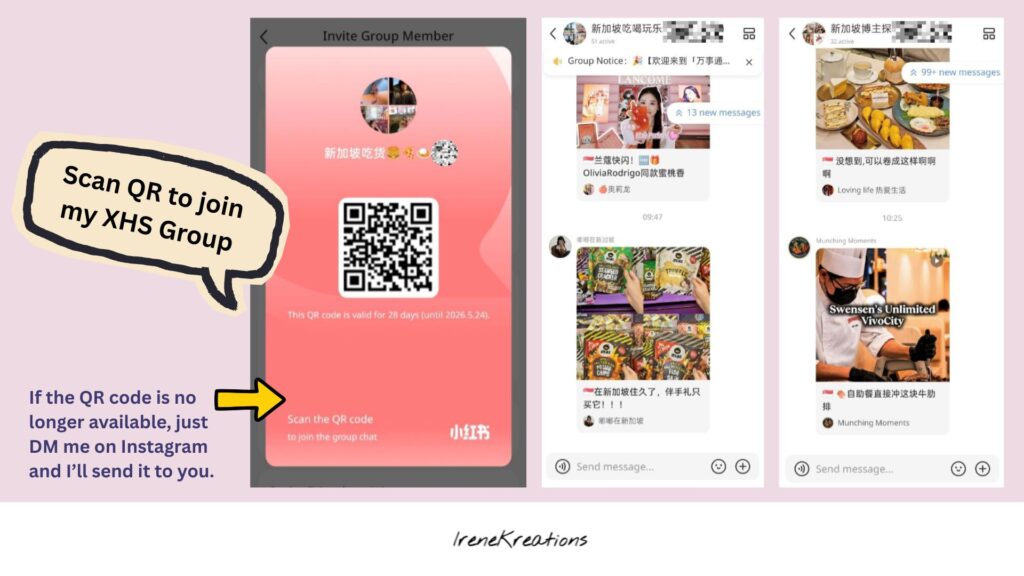
I’ve created a foodie group on Rednote for the Singapore context, but I’ve noticed not many people are using it yet—most likely because they’re unaware of the benefits.
So I’m sharing this to explain this, and how you can actually benefit from it.
This is intentional.
We noticed:
- Restaurants struggle to get authentic exposure
- Influencers struggle to gain higher views or followers
- Content feels transactional, not experiential
So we created a space where:
👉 Restaurant owners
👉 Foodie influencers
Can share content organically, not forcefully
I’ve grown a decent number of followers just by sharing content into groups. A lot of group members ended up following me simply because the content aligned with what they were already interested in. Join my Group here.
If you’re a restaurant owner:
You probably don’t need more ads.
You need better positioning and real conversations.
If you’re a foodie influencer:
You don’t need more invites just yet.
You need content that builds trust and recall.
Summing up, you Don’t Need More Content
You need:
- Better clarity
- Better distribution
- Better thinking
That’s what IreneKreations teaches.
✧⭒✦✧⭒✦◇ Get Social Media | Branding | Marketing | Content Strategy Support in Singapore ✦⭒✧✦⭒✧
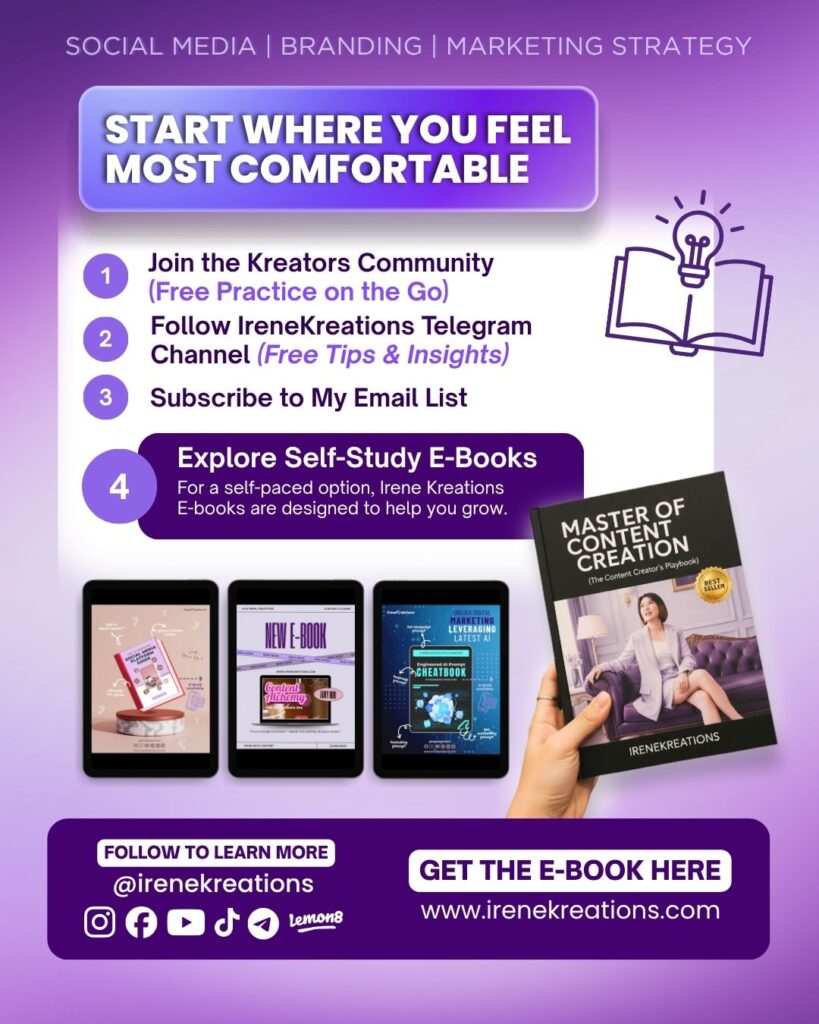
You can start in a way that feels more comfortable:
1. Join the Kreators Community (Free)
A supportive, non-transactional space where creators and business owners come together to learn, share, and grow.
It’s not about hard selling or competition — it’s more like a kampung-style environment where people:
-Exchange ideas and experiences
-Learn from Irene on the ground in a practical content creation session
-Build genuine connections with other creators & business owners
The focus is on growing together, not performing alone.
👉 [Join Kreators Community]
2. Explore Self-Study E-Books
If you prefer to process things at your own pace, IreneKreations E-books are designed to help you:
-Think clearer about your content and positioning (for a specific niche)
-Understand why you’re stuck (not just what to do)
-Build your own structure without overwhelm
👉 [Browse Growth Hacks E-Books Library]
3. Follow My Telegram Channel (Free Tips & Insights)
If you’re still observing and learning, this is a good place to start.
I regularly share:
-Practical content and branding insights
-Realtime Tips or Customer’s Proven Case Study
-Real thoughts behind strategy (not just surface tips)
-Observations from real business and creator experiences
-At times, leveraging AI for content marketing tips
👉 [Join IreneKreations Telegram Channel]
4. Subscribe to My Email List (Free Insights)
If you prefer something simple, you can join my mailing list.
This is where I share:
-Deeper breakdowns of Marketing knowledge and experience sharing
-Insights I don’t always post on social media
-Practical reflections to help you think more clearly about your direction
It’s designed for people who want steady clarity over time, not just quick tips.
👉 [Subscribe to Email List]
You don’t have to figure everything out alone.
But you also don’t have to rush your process.
Whether you prefer:
-Talking things through
-Learning at your own pace
-Getting small consistent insights
-Or simply observing for now
There’s a space for you here, built and supported by IreneKreations.